Ch.12 - Solids and Modern Materials
Brown - Chemistry: The Central Science 14th Edition
Brown14th EditionChemistry: The Central ScienceISBN: 9780134414232당신이 사용하는 게 아니라요?교과서 변경
12장, 문제 56

For each of the following groups, which metal would you expect to have the highest melting point: (b) rubidium, molybdenum, or indium?

검증된 단계별 안내
1
insert step 1> Identify the metals in the group: rubidium (Rb), molybdenum (Mo), and indium (In).
insert step 2> Consider the position of each metal in the periodic table. Rubidium is an alkali metal, molybdenum is a transition metal, and indium is a post-transition metal.
insert step 3> Recall that transition metals generally have higher melting points than alkali and post-transition metals due to stronger metallic bonding and more delocalized electrons.
insert step 4> Compare the typical melting points of each type of metal: alkali metals like rubidium have relatively low melting points, post-transition metals like indium have moderate melting points, and transition metals like molybdenum have high melting points.
insert step 5> Conclude that molybdenum, being a transition metal, is expected to have the highest melting point among the three metals.

비슷한 문제에 대한 검증된 영상 답변:

이 영상 해법은 위 문제에 도움이 된다고 튜터들이 추천한 것입니다.
영상 길이:
3m

주요 개념

질문에 올바르게 답하기 위해 반드시 이해해야 하는 핵심 개념들은 다음과 같습니다.

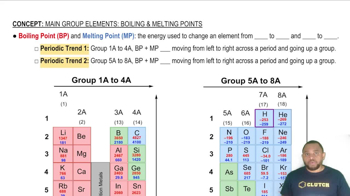
Melting Point Trends

The melting point of a metal is influenced by its atomic structure and bonding. Generally, metals with stronger metallic bonds and higher atomic numbers tend to have higher melting points. Transition metals, like molybdenum, often exhibit higher melting points due to their ability to form strong metallic bonds through d-orbitals.
추천 영상:
가이드 코스
04:29
Boiling Point and Melting Point

Metal Classification

Metals can be classified into different categories, including alkali metals, transition metals, and post-transition metals. Rubidium is an alkali metal, which typically has lower melting points compared to transition metals. Molybdenum, a transition metal, is known for its high melting point due to its dense atomic structure and strong bonding characteristics.
추천 영상:
가이드 코스
04:22
Ligand Classification

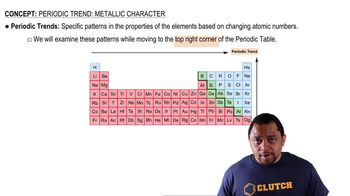
Periodic Trends

Periodic trends refer to the predictable patterns in the properties of elements as you move across or down the periodic table. For instance, melting points generally increase across a period and decrease down a group for metals. Understanding these trends helps in predicting the melting points of different metals based on their position in the periodic table.
추천 영상:
가이드 코스
00:38
Periodic Trends