
Aerosols are important components of the atmosphere. Does the presence of aerosols in the atmosphere increase or decrease the amount of sunlight that arrives at the Earth's surface, compared to an 'aerosol-free' atmosphere? Explain your reasoning.
Ch.13 - Properties of Solutions
13장, 문제 83
The osmotic pressure of a 0.010 M aqueous solution of CaCl2 is found to be 0.674 atm at 25 °C. Calculate the van't Hoff factor, i, for the solution.
검증된 단계별 안내1
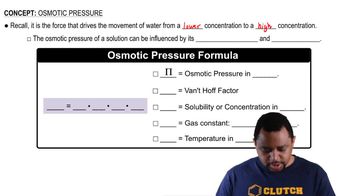
Identify the formula for osmotic pressure: \( \Pi = iMRT \), where \( \Pi \) is the osmotic pressure, \( i \) is the van't Hoff factor, \( M \) is the molarity, \( R \) is the ideal gas constant, and \( T \) is the temperature in Kelvin.
Convert the temperature from Celsius to Kelvin: \( T = 25 + 273.15 \).
Use the given values: \( \Pi = 0.674 \) atm, \( M = 0.010 \) M, \( R = 0.0821 \) L·atm/mol·K, and the converted temperature \( T \).
Rearrange the formula to solve for the van't Hoff factor \( i \): \( i = \frac{\Pi}{MRT} \).
Substitute the known values into the rearranged formula to calculate \( i \).

비슷한 문제에 대한 검증된 영상 답변:
이 영상 해법은 위 문제에 도움이 된다고 튜터들이 추천한 것입니다.
영상 길이:
3m주요 개념
질문에 올바르게 답하기 위해 반드시 이해해야 하는 핵심 개념들은 다음과 같습니다.
Osmotic Pressure
Osmotic pressure is the pressure required to prevent the flow of solvent into a solution through a semipermeable membrane. It is directly proportional to the concentration of solute particles in the solution and can be calculated using the formula π = iCRT, where π is the osmotic pressure, i is the van't Hoff factor, C is the molarity of the solution, R is the ideal gas constant, and T is the temperature in Kelvin.
추천 영상:
가이드 코스
Osmotic Pressure Formula
van't Hoff Factor (i)
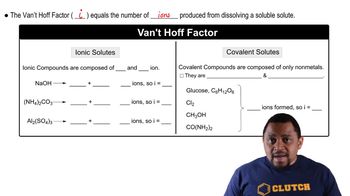
The van't Hoff factor, denoted as i, represents the number of particles into which a solute dissociates in solution. For ionic compounds, i is greater than 1, as they separate into multiple ions. For example, CaCl2 dissociates into one calcium ion (Ca²⁺) and two chloride ions (Cl⁻), resulting in a van't Hoff factor of 3. This factor is crucial for calculating colligative properties like osmotic pressure.
추천 영상:
가이드 코스
Van't Hoff Factor
Colligative Properties
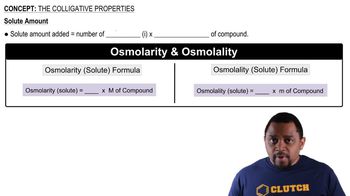
Colligative properties are properties of solutions that depend on the number of solute particles rather than their identity. These properties include boiling point elevation, freezing point depression, vapor pressure lowering, and osmotic pressure. Understanding colligative properties is essential for predicting how solute concentration affects the physical behavior of solutions, particularly in the context of osmotic pressure calculations.
추천 영상:
가이드 코스
Colligative Properties
관련 실천
교과서 질문
507
views
교과서 질문
Lysozyme is an enzyme that breaks bacterial cell walls. A solution containing 0.150 g of this enzyme in 210 mL of solution has an osmotic pressure of 0.953 torr at 25 °C. What is the molar mass of lysozyme?
2030
views
교과서 질문
A dilute aqueous solution of an organic compound soluble in water is formed by dissolving 2.35 g of the compound in water to form 0.250 L of solution. The resulting solution has an osmotic pressure of 0.605 atm at 25 °C. Assuming that the organic compound is a nonelectrolyte, what is its molar mass?
1036
views
교과서 질문
Lauryl alcohol is obtained from coconut oil and is used to
make detergents. A solution of 5.00 g of lauryl alcohol in
0.100 kg of benzene freezes at 4.1 °C. What is the molar
mass of lauryl alcohol from this data?
2267
views
