Which diagram best represents a liquid–liquid emulsion such as milk? The colored balls represent different liquid molecules. [Section 13.6]
Ch.13 - Properties of Solutions
13장, 문제 10b
This portion of a phase diagram shows the vapor–pressure curves of a volatile solvent and of a solution of that solvent containing a nonvolatile solute. (b) What are the normal boiling points of the solvent and the solution? [Section 13.5]
검증된 단계별 안내1
Identify the phase diagram provided in the problem, focusing on the vapor-pressure curves for both the pure solvent and the solution.
Recall that the normal boiling point of a substance is the temperature at which its vapor pressure equals 1 atm (or 760 mmHg).
Locate the point on the vapor-pressure curve of the pure solvent where the pressure is 1 atm. The corresponding temperature is the normal boiling point of the solvent.
Similarly, locate the point on the vapor-pressure curve of the solution where the pressure is 1 atm. The corresponding temperature is the normal boiling point of the solution.
Note that the presence of a nonvolatile solute typically lowers the vapor pressure of the solution, resulting in a higher boiling point compared to the pure solvent. This phenomenon is known as boiling point elevation.

비슷한 문제에 대한 검증된 영상 답변:
이 영상 해법은 위 문제에 도움이 된다고 튜터들이 추천한 것입니다.
영상 길이:
1m주요 개념
질문에 올바르게 답하기 위해 반드시 이해해야 하는 핵심 개념들은 다음과 같습니다.
Phase Diagram
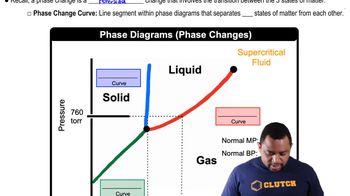
A phase diagram is a graphical representation that shows the phases of a substance at various temperatures and pressures. It illustrates the conditions under which distinct phases, such as solid, liquid, and gas, coexist. Understanding phase diagrams is crucial for interpreting the behavior of substances, particularly in relation to boiling points and vapor pressures.
추천 영상:
가이드 코스
Phase Changes in Diagrams
Vapor Pressure
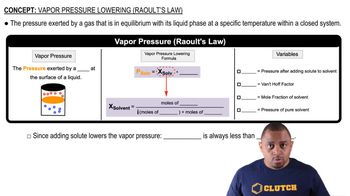
Vapor pressure is the pressure exerted by a vapor in equilibrium with its liquid or solid form at a given temperature. It indicates how readily a substance will evaporate and is a key factor in determining boiling points. The normal boiling point of a liquid is defined as the temperature at which its vapor pressure equals atmospheric pressure, typically 1 atm.
추천 영상:
가이드 코스
Raoult's Law and Vapor Pressure
Colligative Properties
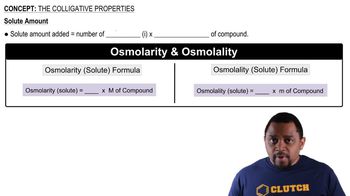
Colligative properties are properties of solutions that depend on the number of solute particles in a given amount of solvent, rather than the identity of the solute. These properties include boiling point elevation and freezing point depression. When a nonvolatile solute is added to a solvent, the boiling point of the solution increases compared to that of the pure solvent, which is essential for determining the boiling points in the given question.
추천 영상:
가이드 코스
Colligative Properties
관련 실천
교과서 질문
1002
views
교과서 질문
Suppose you had a balloon made of some highly flexible semipermeable membrane. The balloon is filled completely with a 0.2 M solution of some solute and is submerged in a 0.1 M solution of the same solute:
Initially, the volume of solution in the balloon is 0.25 L. Assuming the volume outside the semipermeable membrane is large, as the illustration shows, what would you expect for the solution volume inside the balloon once the system has come to equilibrium through osmosis? [Section 13.5]
451
views
교과서 질문
The figure shows two identical volumetric flasks containing the same solution at two temperatures. (b) Does the molality of the solution change with the change in temperature? [Section 13.4]
505
views