
Ch.14 - Chemical Kinetics
Brown - Chemistry: The Central Science 14th Edition
Brown14th EditionChemistry: The Central ScienceISBN: 9780134414232당신이 사용하는 게 아니라요?교과서 변경
14장, 문제 80b

The addition of NO accelerates the decomposition of N2O, possibly by the following mechanism: NO1g2 + N2O1g2¡N21g2 + NO21g2 2 NO21g2¡2 NO1g2 + O21g2 (b) Is NO serving as a catalyst or an intermediate in this reaction?

검증된 단계별 안내
1
Step 1: Understand the difference between a catalyst and an intermediate. A catalyst is a substance that speeds up a reaction without being consumed in the process. An intermediate, on the other hand, is a substance that is produced in one step of a reaction and consumed in a subsequent step.
Step 2: Look at the given reaction mechanism. The substance NO is initially consumed in the first step of the reaction, but it is regenerated in the second step.
Step 3: Since NO is consumed and then produced again in the reaction, it is not permanently consumed or produced in the overall reaction.
Step 4: Therefore, NO is acting as a catalyst in this reaction because it is not consumed in the overall reaction and it speeds up the reaction.

비슷한 문제에 대한 검증된 영상 답변:

이 영상 해법은 위 문제에 도움이 된다고 튜터들이 추천한 것입니다.
영상 길이:
2m

주요 개념

질문에 올바르게 답하기 위해 반드시 이해해야 하는 핵심 개념들은 다음과 같습니다.

Catalysts

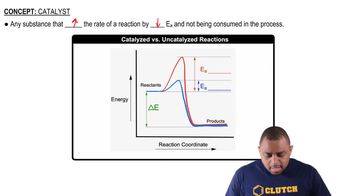
A catalyst is a substance that increases the rate of a chemical reaction without being consumed in the process. It works by providing an alternative reaction pathway with a lower activation energy. Catalysts can be reused multiple times, making them essential in many industrial and biological processes.
추천 영상:
가이드 코스
01:59
Catalyzed vs. Uncatalyzed Reactions

Intermediates

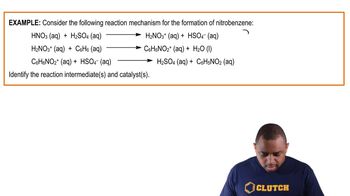
An intermediate is a transient species formed during the course of a chemical reaction. Intermediates are not present in the initial reactants or final products but are crucial for the reaction mechanism. They typically have a short lifespan and can be difficult to detect, as they often react quickly to form the final products.
추천 영상:
가이드 코스
02:14
Reaction Mechanism Example

Reaction Mechanism

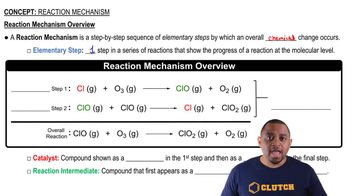
A reaction mechanism is a detailed description of the step-by-step process by which reactants are converted into products. It includes the sequence of elementary steps, the formation of intermediates, and the role of catalysts. Understanding the mechanism helps chemists predict the behavior of reactions and design more efficient processes.
추천 영상:
가이드 코스
03:06
Reaction Mechanism Overview