
From the following data for the first-order gas-phase isomerization of CH3NC at 215 C, calculate the firstorder rate constant and half-life for the reaction: Time (s) Pressure CH3nC (torr) 0 502 2000 335 5000 180 8000 95.5 12,000 41.7 15,000 22.4
Ch.14 - Chemical Kinetics
14장, 문제 44c
The first-order rate constant for the decomposition of N2O5, 2 N2O5(g) → 4 NO2(g) + O2(g), at 70°C is 6.82×10⁻³ s-1. Suppose we start with 0.0250 mol of N2O5(g) in a volume of 2.0 L. (c) What is the half-life of N2O5 at 70°C?
검증된 단계별 안내1
Step 1: Understand that the half-life of a first-order reaction is given by the formula t1/2 = 0.693/k, where k is the rate constant.
Step 2: Identify the given rate constant (k) from the problem, which is 6.82 * 10^-3 s^-1.
Step 3: Substitute the given rate constant into the half-life formula.
Step 4: Solve the equation for t1/2 to find the half-life of N2O5 at 70 C.

비슷한 문제에 대한 검증된 영상 답변:
이 영상 해법은 위 문제에 도움이 된다고 튜터들이 추천한 것입니다.
영상 길이:
1m주요 개념
질문에 올바르게 답하기 위해 반드시 이해해야 하는 핵심 개념들은 다음과 같습니다.
First-Order Reactions
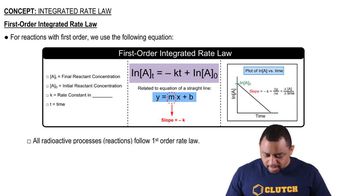
First-order reactions are chemical reactions where the rate is directly proportional to the concentration of one reactant. In these reactions, the rate constant (k) remains constant, and the concentration of the reactant decreases exponentially over time. The half-life of a first-order reaction is independent of the initial concentration, making it a key characteristic for calculations involving such reactions.
추천 영상:
가이드 코스
First-Order Reactions
Half-Life
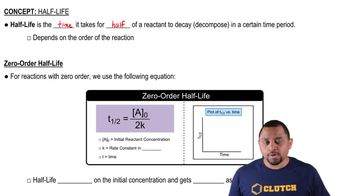
The half-life of a substance is the time required for half of the initial amount of that substance to undergo a reaction or decay. For first-order reactions, the half-life can be calculated using the formula t1/2 = 0.693/k, where k is the rate constant. This concept is crucial for understanding how quickly a reactant is consumed in a reaction and is particularly useful in kinetics.
추천 영상:
가이드 코스
Zero-Order Half-life
Rate Constant
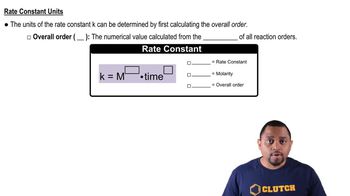
The rate constant (k) is a proportionality factor in the rate equation that relates the rate of a reaction to the concentration of reactants. It is specific to a given reaction at a particular temperature and is essential for calculating reaction rates and half-lives. In the context of first-order reactions, the rate constant directly influences the duration of the half-life and the speed of the reaction.
추천 영상:
가이드 코스
Rate Constant Units
관련 실천
교과서 질문
1191
views
교과서 질문
The first-order rate constant for the decomposition of N2O5, 2 N2O5(g) → 4 NO2(g) + O2(g), at 70°C is 6.82×10⁻³ s-1. Suppose we start with 0.0250 mol of N2O5(g) in a volume of 2.0 L. (a) How many moles of N2O5 will remain after 5.0 min?
2863
views
교과서 질문
As described in Exercise 14.41, the decomposition of sulfuryl chloride (SO2Cl2) is a first-order process. The rate constant for the decomposition at 660 K is 4.5 × 10⁻² s-1. (b) At what time will the partial pressure of SO2Cl2 decline to one-tenth its initial value?
1755
views
교과서 질문
Consider the data presented in Exercise 14.19. (a) By using appropriate graphs, determine whether the reaction is first order or second order.
