Ch.14 - Chemical Kinetics
Brown - Chemistry: The Central Science 14th Edition
Brown14th EditionChemistry: The Central ScienceISBN: 9780134414232당신이 사용하는 게 아니라요?교과서 변경
14장, 문제 49a,c

The gas-phase decomposition of NO2, 2 NO2(g) → 2 NO(g) + O2(g), is studied at 383°C, giving the following data:
Time (s) [NO2] (M)
0.0 0.100
5.0 0.017
10.0 0.0090
15.0 0.0062
20.0 0.0047 
(a) Is the reaction first order or second order with respect to the concentration of NO2?
(c) Predict the reaction rates at the beginning of the reaction for initial concentrations of 0.200 M, 0.100 M, and 0.050 M NO2.

검증된 단계별 안내
1
Identify the rate law for the reaction. Since the reaction is 2 NO_2 \(\rightarrow\) 2 NO + O_2, it is likely a second-order reaction with respect to NO_2.
Use the integrated rate law for a second-order reaction: \( \frac{1}{[A]} = kt + \frac{1}{[A]_0} \), where \([A]\) is the concentration of NO_2 at time \(t\), \([A]_0\) is the initial concentration, and \(k\) is the rate constant.
Calculate the rate constant \(k\) using the given data. Choose two data points, for example, \([NO_2]_0 = 0.100\, M\) at \(t = 0\, s\) and \([NO_2] = 0.017\, M\) at \(t = 5.0\, s\), and substitute into the integrated rate law to solve for \(k\).
Once \(k\) is determined, use the rate law \(rate = k[NO_2]^2\) to calculate the initial reaction rates for the given initial concentrations: 0.200 M, 0.100 M, and 0.050 M.
Substitute each initial concentration into the rate law to find the initial rate for each concentration. Remember, the rate is dependent on the square of the concentration for a second-order reaction.

비슷한 문제에 대한 검증된 영상 답변:

이 영상 해법은 위 문제에 도움이 된다고 튜터들이 추천한 것입니다.
영상 길이:
7m

주요 개념

질문에 올바르게 답하기 위해 반드시 이해해야 하는 핵심 개념들은 다음과 같습니다.

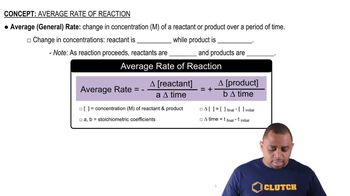
Reaction Rate

The reaction rate is a measure of how quickly reactants are converted into products in a chemical reaction. It is typically expressed as the change in concentration of a reactant or product per unit time. Understanding how to calculate and interpret reaction rates is essential for predicting the behavior of a reaction under varying conditions.
추천 영상:
가이드 코스
02:03
Average Rate of Reaction

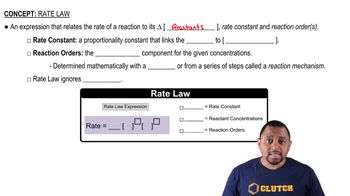
Rate Law

The rate law is an equation that relates the rate of a reaction to the concentration of its reactants, typically in the form Rate = k [A]^m [B]^n, where k is the rate constant, and m and n are the orders of the reaction with respect to reactants A and B. This concept is crucial for predicting how changes in concentration affect the reaction rate.
추천 영상:
가이드 코스
01:52
Rate Law Fundamentals

Concentration and Its Effect on Reaction Rate

The concentration of reactants plays a significant role in determining the rate of a chemical reaction. Generally, an increase in the concentration of reactants leads to a higher reaction rate due to more frequent collisions between reactant molecules. This principle is fundamental when predicting reaction rates for different initial concentrations.
추천 영상:
가이드 코스
02:03
Average Rate of Reaction