

Ch.14 - Chemical Kinetics
Brown - Chemistry: The Central Science 14th Edition
Brown14th EditionChemistry: The Central ScienceISBN: 9780134414232당신이 사용하는 게 아니라요?교과서 변경
14장, 문제 55a

The gas-phase reaction Cl(g) + HBr(g) → HCl(g) + Br(g) has an overall energy change of -66 kJ. The activation energy for the reaction is 7 kJ. (a) Sketch the energy profile for the reaction, and label Ea and ΔE.

검증된 단계별 안내
1
Identify the key components to be included in the energy profile diagram: reactants, products, activation energy (Ea), and overall energy change (ΔE).
Start by drawing a horizontal line representing the energy level of the reactants. Label this line as 'Reactants'.
Above the reactants line, mark a point that represents the peak energy level the reaction must reach before proceeding to products. This point is the activation energy (Ea). Label this point and draw an arrow from the reactants line to this point, indicating the energy input needed to reach this state.
From the peak, draw a line descending to the energy level of the products, which is lower than that of the reactants by 66 kJ, as given by the overall energy change (ΔE). Label this line as 'Products'.
On the diagram, clearly label the activation energy (Ea) as 7 kJ above the reactants' energy and the overall energy change (ΔE) as -66 kJ below the reactants' energy.

비슷한 문제에 대한 검증된 영상 답변:

이 영상 해법은 위 문제에 도움이 된다고 튜터들이 추천한 것입니다.
영상 길이:
1m

주요 개념

질문에 올바르게 답하기 위해 반드시 이해해야 하는 핵심 개념들은 다음과 같습니다.

Energy Profile Diagrams

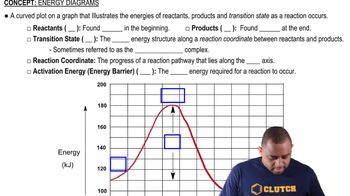
Energy profile diagrams visually represent the energy changes during a chemical reaction. They plot the energy of the system against the progress of the reaction, showing the energy of reactants, products, and the activation energy (Ea). The diagram helps illustrate whether a reaction is exothermic or endothermic, as well as the energy barrier that must be overcome for the reaction to proceed.
추천 영상:
가이드 코스
01:57
Energy Diagrams

Activation Energy (Ea)

Activation energy is the minimum energy required for reactants to undergo a chemical reaction. It represents the energy barrier that must be overcome for the reaction to proceed. In the given reaction, the activation energy is 7 kJ, indicating that this amount of energy must be supplied to initiate the reaction, regardless of whether the overall reaction is exothermic or endothermic.
추천 영상:
가이드 코스
02:02
Activity Series Chart

Enthalpy Change (ΔE)

The enthalpy change (ΔE) of a reaction indicates the difference in energy between the reactants and products. A negative ΔE, such as -66 kJ in this case, signifies that the reaction releases energy to the surroundings, classifying it as exothermic. This value is crucial for understanding the thermodynamics of the reaction and its favorability under standard conditions.
추천 영상:
가이드 코스
02:34
Enthalpy of Formation