Ch.14 - Chemical Kinetics
Brown - Chemistry: The Central Science 14th Edition
Brown14th EditionChemistry: The Central ScienceISBN: 9780134414232당신이 사용하는 게 아니라요?교과서 변경
14장, 문제 101d

The rate of a first-order reaction is followed by spectroscopy, monitoring the absorbance of a colored reactant at 520 nm. The reaction occurs in a 1.00-cm sample cell, and the only colored species in the reaction has an extinction coefficient of 5.60 × 10³ M-1 cm-1 at 520 nm.
(d) How long does it take for the absorbance to fall to 0.100?

검증된 단계별 안내
1
Identify the relationship between absorbance and concentration using Beer's Law: \( A = \varepsilon c l \), where \( A \) is absorbance, \( \varepsilon \) is the extinction coefficient, \( c \) is the concentration, and \( l \) is the path length.
Since the reaction is first-order, use the first-order kinetics equation: \( \ln \left( \frac{[A]_0}{[A]} \right) = kt \), where \([A]_0\) is the initial concentration, \([A]\) is the concentration at time \( t \), and \( k \) is the rate constant.
Relate the initial and final absorbance to concentration using Beer's Law: \( A_0 = \varepsilon [A]_0 l \) and \( A = \varepsilon [A] l \).
Substitute the expressions for \([A]_0\) and \([A]\) from Beer's Law into the first-order kinetics equation: \( \ln \left( \frac{A_0}{A} \right) = kt \).
Solve for \( t \) using the given values: \( A_0 \) (initial absorbance), \( A = 0.100 \), and the calculated rate constant \( k \).

비슷한 문제에 대한 검증된 영상 답변:

이 영상 해법은 위 문제에 도움이 된다고 튜터들이 추천한 것입니다.
영상 길이:
3m

주요 개념

질문에 올바르게 답하기 위해 반드시 이해해야 하는 핵심 개념들은 다음과 같습니다.

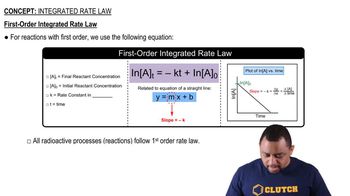
First-Order Reaction Kinetics

First-order reactions are characterized by a rate that is directly proportional to the concentration of one reactant. The rate law for a first-order reaction can be expressed as rate = k[A], where k is the rate constant and [A] is the concentration of the reactant. The integrated rate law for such reactions allows us to relate concentration and time, which is essential for calculating how long it takes for the absorbance to change.
추천 영상:
가이드 코스
02:29
First-Order Reactions

Beer-Lambert Law

The Beer-Lambert Law describes the relationship between absorbance (A), concentration (c), and path length (l) in a solution, expressed as A = εcl. Here, ε is the molar absorptivity or extinction coefficient. This law is crucial for determining the concentration of the colored reactant from its absorbance at a specific wavelength, allowing us to track the progress of the reaction over time.
추천 영상:

Extinction Coefficient

The extinction coefficient (ε) is a measure of how strongly a chemical species absorbs light at a given wavelength, expressed in units of M^-1 cm^-1. In this context, it quantifies the absorbance of the colored reactant at 520 nm, enabling the calculation of concentration changes as the reaction proceeds. Understanding this coefficient is vital for applying the Beer-Lambert Law to determine how long it takes for the absorbance to reach a specified value.
추천 영상:
가이드 코스
03:29
Electron Capture & Positron Emission Reaction Example