
Ch.15 - Chemical Equilibrium
Brown - Chemistry: The Central Science 14th Edition
Brown14th EditionChemistry: The Central ScienceISBN: 9780134414232당신이 사용하는 게 아니라요?교과서 변경
15장, 문제 82

A 0.831-g sample of SO3 is placed in a 1.00-L container and heated to 1100 K. The SO3 decomposes to SO2 and O2: 2SO3(𝑔) ⇌ 2 SO2(𝑔) + O2(𝑔) At equilibrium, the total pressure in the container is 1.300 atm. Find the values of 𝐾𝑝 and 𝐾𝑐 for this reaction at 1100 K.

검증된 단계별 안내
1
Calculate the initial moles of SO3 using its molar mass. Use the formula: moles = mass (g) / molar mass (g/mol).
Set up an ICE table (Initial, Change, Equilibrium) for the reaction: 2SO3(g) ⇌ 2SO2(g) + O2(g). Assume x moles of SO3 decompose, then 2x moles of SO2 and x moles of O2 are formed.
Calculate the equilibrium partial pressures of SO3, SO2, and O2 using the ideal gas law (PV = nRT), where P is the partial pressure, n is the number of moles at equilibrium, R is the gas constant, and T is the temperature in Kelvin.
Use the equilibrium partial pressures to find the equilibrium constant Kp for the reaction. Apply the formula for Kp: Kp = (PSO2)2 * PO2 / (PSO3)2.
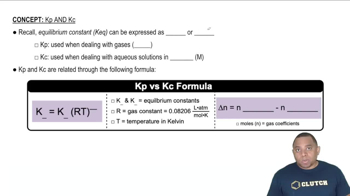
Convert Kp to Kc using the relationship Kc = Kp / (RT)Δn, where Δn is the change in moles of gas (products minus reactants) and T is the temperature in Kelvin.

비슷한 문제에 대한 검증된 영상 답변:

이 영상 해법은 위 문제에 도움이 된다고 튜터들이 추천한 것입니다.
영상 길이:
13m

주요 개념

질문에 올바르게 답하기 위해 반드시 이해해야 하는 핵심 개념들은 다음과 같습니다.

Equilibrium Constant (Kp and Kc)

The equilibrium constant (K) quantifies the ratio of the concentrations of products to reactants at equilibrium for a given reaction. Kp is used when dealing with partial pressures of gases, while Kc is used for concentrations in molarity. For the reaction 2SO3(g) ⇌ 2SO2(g) + O2(g), Kp can be calculated using the expression Kp = (P_SO2^2 * P_O2) / (P_SO3^2), where P represents the partial pressures of the gases involved.
추천 영상:
가이드 코스
02:06
Kp vs. Kc Formula

Decomposition Reaction

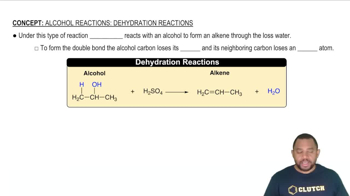
A decomposition reaction is a type of chemical reaction where a single compound breaks down into two or more simpler products. In this case, sulfur trioxide (SO3) decomposes into sulfur dioxide (SO2) and oxygen (O2). Understanding the stoichiometry of the reaction is crucial for calculating the equilibrium concentrations and subsequently the equilibrium constants.
추천 영상:
가이드 코스
01:30
Alcohol Reactions: Dehydration Reactions

Ideal Gas Law

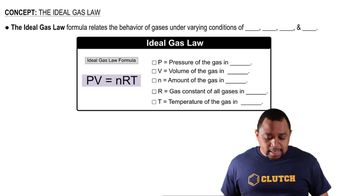
The Ideal Gas Law (PV = nRT) relates the pressure (P), volume (V), number of moles (n), the ideal gas constant (R), and temperature (T) of a gas. In this problem, the total pressure at equilibrium and the volume of the container are used to determine the number of moles of each gas present. This information is essential for calculating the equilibrium concentrations needed to find Kc.
추천 영상:
가이드 코스
01:15
Ideal Gas Law Formula