Ch.15 - Chemical Equilibrium
Brown - Chemistry: The Central Science 14th Edition
Brown14th EditionChemistry: The Central ScienceISBN: 9780134414232당신이 사용하는 게 아니라요?교과서 변경
15장, 문제 36

A mixture of 1.374 g of H2 and 70.31 g of Br2 is heated in a 2.00-L vessel at 700 K. These substances react according to H2(g) + Br2(g) ⇌ 2 HBr(g). At equilibrium, the vessel is found to contain 0.566 g of H2. (a) Calculate the equilibrium concentrations of H2, Br2, and HBr.

검증된 단계별 안내
1
Step 1: Convert the initial masses of H2 and Br2 to moles using their molar masses. The molar mass of H2 is approximately 2.02 g/mol, and the molar mass of Br2 is approximately 159.81 g/mol.
Step 2: Calculate the initial concentrations of H2 and Br2 by dividing the moles of each by the volume of the vessel (2.00 L).
Step 3: Determine the change in moles of H2 from the initial state to equilibrium by converting the equilibrium mass of H2 (0.566 g) to moles and subtracting it from the initial moles of H2.
Step 4: Use the stoichiometry of the balanced chemical equation to find the change in moles of Br2 and HBr. Since the reaction is 1:1:2, the change in moles of Br2 will be the same as H2, and the change in moles of HBr will be twice that of H2.
Step 5: Calculate the equilibrium concentrations of H2, Br2, and HBr by adjusting the initial concentrations with the changes calculated in Step 4 and dividing by the volume of the vessel (2.00 L).

주요 개념

질문에 올바르게 답하기 위해 반드시 이해해야 하는 핵심 개념들은 다음과 같습니다.

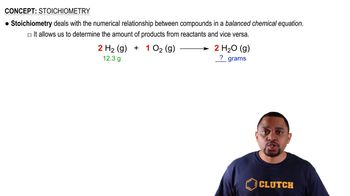
Stoichiometry

Stoichiometry is the calculation of reactants and products in chemical reactions based on the balanced chemical equation. In this case, the reaction between hydrogen (H2) and bromine (Br2) to form hydrogen bromide (HBr) follows a 1:1:2 molar ratio. Understanding stoichiometry is essential for determining how much of each substance is consumed or produced at equilibrium.
추천 영상:
가이드 코스
01:16
Stoichiometry Concept

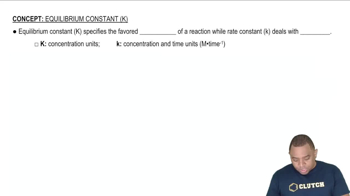
Equilibrium Constant

Chemical equilibrium occurs when the rates of the forward and reverse reactions are equal, resulting in constant concentrations of reactants and products. The equilibrium constant (K) can be used to express the ratio of the concentrations of products to reactants at equilibrium. This concept is crucial for calculating the concentrations of H2, Br2, and HBr in the given reaction.
추천 영상:
가이드 코스
01:14
Equilibrium Constant K

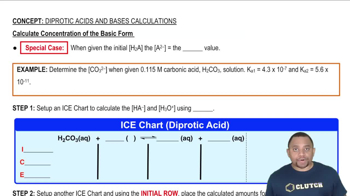
Concentration Calculations

Concentration is defined as the amount of a substance per unit volume of solution, typically expressed in moles per liter (M). To find the equilibrium concentrations of H2, Br2, and HBr, one must convert the masses of the substances into moles and then divide by the volume of the vessel. This step is vital for accurately determining the concentrations at equilibrium.
추천 영상:
가이드 코스
07:35
Calculate Concentration of the Basic Form