Ch.15 - Chemical Equilibrium
15์žฅ, ๋ฌธ์ œ 25a,b

At 1000 K, ๐พ๐‘ = 1.85 for the reaction SO2(๐‘”) + 1/2 O2(๐‘”) โ‡Œ SO3(๐‘”) (a) What is the value of Kp for the reaction SO3(๐‘”) โ‡Œ SO2(๐‘”) + 1/2 O2(๐‘”)? (b) What is the value of Kp for the reaction 2 SO2(๐‘”) + O2(๐‘”) โ‡Œ 2 SO3(๐‘”)?

๊ฒ€์ฆ๋œ ๋‹จ๊ณ„๋ณ„ ์•ˆ๋‚ด
1
To find the value of Kp for the reverse reaction SO3(g) โ‡Œ SO2(g) + 1/2 O2(g), we need to take the reciprocal of the given Kp for the forward reaction. This is because the equilibrium constant for a reverse reaction is the inverse of the equilibrium constant for the forward reaction.
For part (a), calculate the reciprocal of Kp: Kp(reverse) = 1 / Kp(forward). Substitute the given Kp value of 1.85 into this expression.
For part (b), we need to determine the Kp for the reaction 2 SO2(g) + O2(g) โ‡Œ 2 SO3(g). Notice that this reaction is the original reaction multiplied by 2.
When a chemical equation is multiplied by a factor, the equilibrium constant is raised to the power of that factor. Therefore, for the reaction 2 SO2(g) + O2(g) โ‡Œ 2 SO3(g), Kp(new) = (Kp(original))^2.
Substitute the given Kp value of 1.85 into the expression for Kp(new) to find the equilibrium constant for the reaction 2 SO2(g) + O2(g) โ‡Œ 2 SO3(g).

์ฃผ์š” ๊ฐœ๋…

์งˆ๋ฌธ์— ์˜ฌ๋ฐ”๋ฅด๊ฒŒ ๋‹ตํ•˜๊ธฐ ์œ„ํ•ด ๋ฐ˜๋“œ์‹œ ์ดํ•ดํ•ด์•ผ ํ•˜๋Š” ํ•ต์‹ฌ ๊ฐœ๋…๋“ค์€ ๋‹ค์Œ๊ณผ ๊ฐ™์Šต๋‹ˆ๋‹ค.

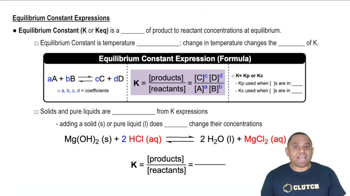
Equilibrium Constant (Kp)

The equilibrium constant, Kp, is a numerical value that expresses the ratio of the concentrations of products to reactants at equilibrium for a given reaction at a specific temperature. It is calculated using the partial pressures of gases involved in the reaction. A larger Kp value indicates a greater concentration of products at equilibrium, while a smaller value suggests a higher concentration of reactants.
์ถ”์ฒœ ์˜์ƒ:
๊ฐ€์ด๋“œ ์ฝ”์Šค
03:20
Equilibrium Constant Expressions

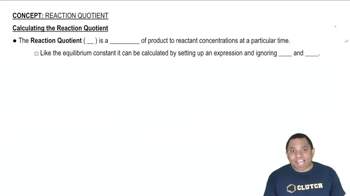
Reaction Quotient (Q)

The reaction quotient, Q, is a measure of the relative amounts of products and reactants present in a reaction at any point in time, not necessarily at equilibrium. It is calculated in the same way as Kp but uses the current concentrations or partial pressures. Comparing Q to Kp helps predict the direction in which a reaction will proceed to reach equilibrium.
์ถ”์ฒœ ์˜์ƒ:

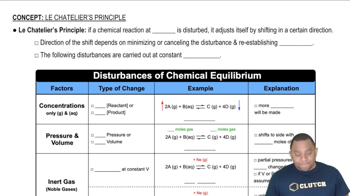
Le Chatelier's Principle

Le Chatelier's Principle states that if a dynamic equilibrium is disturbed by changing the conditions, the system will adjust itself to counteract the change and restore a new equilibrium. This principle is crucial for understanding how changes in concentration, pressure, or temperature affect the position of equilibrium and the values of Kp for related reactions.
์ถ”์ฒœ ์˜์ƒ: