Ch.17 - Additional Aspects of Aqueous Equilibria
Brown - Chemistry: The Central Science 14th Edition
Brown14th EditionChemistry: The Central ScienceISBN: 9780134414232당신이 사용하는 게 아니라요?교과서 변경
17장, 문제 46e,f

Consider the titration of 30.0 mL of 0.050 M NH3 with 0.025 M HCl. Calculate the pH after the following volumes of titrant have been added: (e) 61.0 mL (f) 65.0 mL.

검증된 단계별 안내
1
Identify the reaction: NH_3 (aq) + HCl (aq) \(\rightarrow\) NH_4^+ (aq) + Cl^- (aq).
Calculate the initial moles of NH_3 using its concentration and volume: \(\text{moles NH}\)_3 = 0.050 \(\text{ M}\) \(\times\) 0.030 \(\text{ L}\).
Calculate the moles of HCl added using its concentration and the given volume: \(\text{moles HCl}\) = 0.025 \(\text{ M}\) \(\times\) 0.061 \(\text{ L}\).
Determine the limiting reactant and calculate the moles of NH_3 and NH_4^+ after the reaction.
Use the Henderson-Hasselbalch equation to find the pH: \(\text{pH}\) = \(\text{p}\)K_a + \(\log\) \(\left\)( \(\frac{[\text{base}\)]}{[\(\text{acid}\)]} \(\right\)), where \(\text{p}\)K_a is for NH_4^+.

비슷한 문제에 대한 검증된 영상 답변:

이 영상 해법은 위 문제에 도움이 된다고 튜터들이 추천한 것입니다.
영상 길이:
6m

주요 개념

질문에 올바르게 답하기 위해 반드시 이해해야 하는 핵심 개념들은 다음과 같습니다.

Titration

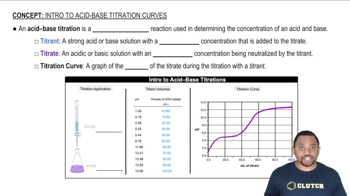
Titration is a quantitative analytical technique used to determine the concentration of a solute in a solution. It involves the gradual addition of a titrant (a solution of known concentration) to a solution of the analyte (the solution of unknown concentration) until the reaction reaches its endpoint, which is often indicated by a color change or a pH change.
추천 영상:
가이드 코스
03:04
Acid-Base Titration

Buffer Solutions

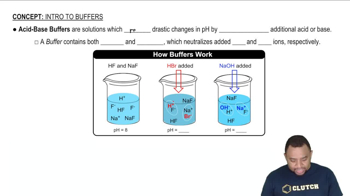
Buffer solutions are mixtures that can resist changes in pH upon the addition of small amounts of acid or base. In the context of the titration of ammonia (NH3), which is a weak base, the resulting solution will contain both the weak base and its conjugate acid (NH4+), forming a buffer that helps maintain the pH within a certain range even as HCl is added.
추천 영상:
가이드 코스
03:02
Buffer Solutions

pH Calculation

The pH of a solution is a measure of its acidity or basicity, calculated as the negative logarithm of the hydrogen ion concentration. In titration problems, pH can be determined by considering the concentrations of the reactants and products at various stages of the titration, particularly at the equivalence point and beyond, where the solution may become acidic or basic depending on the nature of the reactants.
추천 영상:
가이드 코스
02:15
pH Calculation Example