Ch.17 - Additional Aspects of Aqueous Equilibria
Brown - Chemistry: The Central Science 14th Edition
Brown14th EditionChemistry: The Central ScienceISBN: 9780134414232당신이 사용하는 게 아니라요?교과서 변경
17장, 문제 38c

Predict whether the equivalence point of each of the following titrations is below, above, or at pH 7: (c) pyridine titrated with nitric acid.

검증된 단계별 안내
1
Identify the nature of the substances involved in the titration: Pyridine is a weak base, and nitric acid is a strong acid.
Understand the reaction: When a weak base is titrated with a strong acid, the resulting solution at the equivalence point will contain the conjugate acid of the weak base.
Consider the properties of the conjugate acid: The conjugate acid of pyridine is pyridinium ion, which can donate a proton to water, making the solution acidic.
Predict the pH at the equivalence point: Since the solution contains an acidic species (pyridinium ion), the pH at the equivalence point will be below 7.
Conclude: The equivalence point of the titration of pyridine with nitric acid is below pH 7.

비슷한 문제에 대한 검증된 영상 답변:

이 영상 해법은 위 문제에 도움이 된다고 튜터들이 추천한 것입니다.
영상 길이:
1m

주요 개념

질문에 올바르게 답하기 위해 반드시 이해해야 하는 핵심 개념들은 다음과 같습니다.

Acid-Base Titration

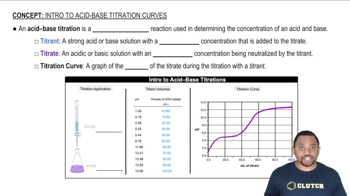
An acid-base titration is a quantitative analytical method used to determine the concentration of an acid or base in a solution. During the titration, a solution of known concentration (the titrant) is added to a solution of unknown concentration until the reaction reaches the equivalence point, where the amount of acid equals the amount of base. The pH at this point can vary depending on the strength of the acid and base involved.
추천 영상:
가이드 코스
03:04
Acid-Base Titration

Strength of Acids and Bases

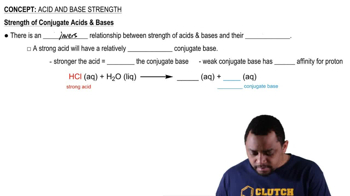
Acids and bases are classified as strong or weak based on their ability to dissociate in water. Strong acids, like nitric acid, completely dissociate into ions, while weak bases, such as pyridine, only partially dissociate. This difference in dissociation affects the pH at the equivalence point of a titration, with strong acids and weak bases typically resulting in a pH below 7 at the equivalence point due to the presence of excess hydrogen ions.
추천 영상:
가이드 코스
00:50
Strength of Conjugate Acids and Bases

Equivalence Point and pH

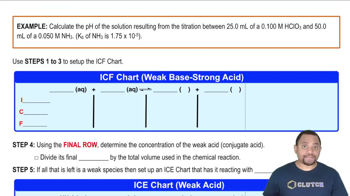
The equivalence point in a titration is the stage at which the amount of titrant added is stoichiometrically equivalent to the amount of substance in the sample. The pH at this point is influenced by the nature of the acid and base involved. In the case of titrating a weak base with a strong acid, the resulting solution will have a pH less than 7 due to the formation of a conjugate acid, which contributes to the acidity of the solution.
추천 영상:
가이드 코스
07:28
pH at the Equivalence Point Example