Ch.18 - Chemistry of the Environment
Brown - Chemistry: The Central Science 14th Edition
Brown14th EditionChemistry: The Central ScienceISBN: 9780134414232당신이 사용하는 게 아니라요?교과서 변경
18장, 문제 82c

The concentration of H2O in the stratosphere is about 5 ppm. It undergoes photodissociation according to: H2O(g) → H(g) + OH(g)
(c) The hydroxyl radical, OH, can react with ozone, giving the following reactions:
OH(g) + O3(g) → HO2(g) + O2(g)
HO2(g) + O(g) → OH(g) + O2(g)
What overall reaction results from these two elementary reactions? What is the catalyst in the overall reaction? Explain.

검증된 단계별 안내
1
Identify the two given elementary reactions: 1) OH(g) + O3(g) → HO2(g) + O2(g) and 2) HO2(g) + O(g) → OH(g) + O2(g).
To find the overall reaction, add the two elementary reactions together. This involves combining all reactants and products from both reactions.
Cancel out any species that appear on both sides of the combined equation. In this case, OH(g) appears as both a reactant and a product, so it can be canceled out.
After canceling, the remaining species will give you the overall reaction. Ensure that the equation is balanced in terms of both atoms and charge.
Identify the catalyst in the reaction. A catalyst is a substance that is present at the start and end of the reaction without being consumed. In this case, OH(g) is regenerated and thus acts as a catalyst.

비슷한 문제에 대한 검증된 영상 답변:

이 영상 해법은 위 문제에 도움이 된다고 튜터들이 추천한 것입니다.
영상 길이:
4m

주요 개념

질문에 올바르게 답하기 위해 반드시 이해해야 하는 핵심 개념들은 다음과 같습니다.

Photodissociation

Photodissociation is a process where a chemical compound breaks down into its components due to the absorption of light energy. In the context of the question, water vapor (H2O) in the stratosphere absorbs ultraviolet light, leading to the formation of hydrogen (H) and hydroxyl radicals (OH). This reaction is significant in atmospheric chemistry as it initiates various reactions involving reactive species.

Elementary Reactions

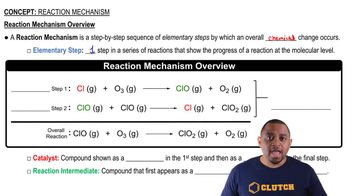
Elementary reactions are the simplest types of chemical reactions that occur in a single step, involving a direct interaction between reactants to form products. The question presents two elementary reactions involving hydroxyl radicals and ozone, which together contribute to the overall reaction. Understanding these reactions is crucial for analyzing how they combine to yield a net reaction.
추천 영상:
가이드 코스
03:06
Reaction Mechanism Overview

Catalysis

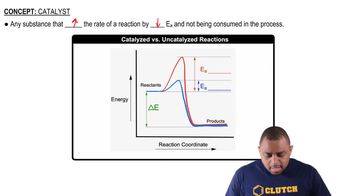
A catalyst is a substance that increases the rate of a chemical reaction without being consumed in the process. In the overall reaction derived from the two elementary reactions, the hydroxyl radical (OH) acts as a catalyst, as it is produced in one of the reactions and consumed in another, facilitating the transformation of ozone (O3) into other products while remaining unchanged.
추천 영상:
가이드 코스
01:59
Catalyzed vs. Uncatalyzed Reactions