Ch.18 - Chemistry of the Environment
Brown - Chemistry: The Central Science 14th Edition
Brown14th EditionChemistry: The Central ScienceISBN: 9780134414232당신이 사용하는 게 아니라요?교과서 변경
18장, 문제 88

The degradation of CF3CH2F (an HFC) by OH radicals in the troposphere is first order in each reactant and has a rate constant of k = 1.6x10^8 M-1s-1 at 4 °C. If the tropospheric concentrations of OH and CF3CH2F are 8.1x10^5 and 6.3x10^8 molecules/cm3, respectively, what is the reaction rate at this temperature in M/s?

검증된 단계별 안내
1
Convert the concentrations of OH and CF3CH2F from molecules/cm³ to molarity (M). Use the conversion factor: 1 mole = 6.022 x 10^23 molecules and 1 cm³ = 1 x 10^-3 L.
Calculate the molarity of OH by dividing the number of molecules by Avogadro's number and then converting cm³ to L.
Calculate the molarity of CF3CH2F using the same method as for OH.
Use the rate law for a second-order reaction: Rate = k[OH][CF3CH2F], where k is the rate constant and [OH] and [CF3CH2F] are the molar concentrations.
Substitute the values of k, [OH], and [CF3CH2F] into the rate equation to find the reaction rate in M/s.

주요 개념

질문에 올바르게 답하기 위해 반드시 이해해야 하는 핵심 개념들은 다음과 같습니다.

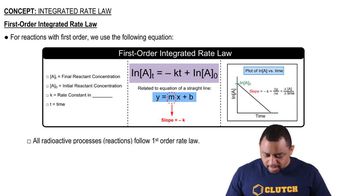
First-Order Reactions

First-order reactions are those where the rate of reaction is directly proportional to the concentration of one reactant. In this case, the degradation of CF3CH2F by OH radicals is first order in both reactants, meaning that the rate can be expressed as rate = k[OH][CF3CH2F], where k is the rate constant. Understanding this relationship is crucial for calculating the reaction rate.
추천 영상:
가이드 코스
02:29
First-Order Reactions

Rate Constant (k)

The rate constant (k) is a proportionality factor that relates the reaction rate to the concentrations of the reactants in a chemical reaction. It is specific to a given reaction at a particular temperature. In this question, the rate constant is given as 1.6x10^8 M-1s-1, which indicates how quickly the reaction occurs under the specified conditions.
추천 영상:
가이드 코스
01:14
Equilibrium Constant K

Concentration Units and Conversion

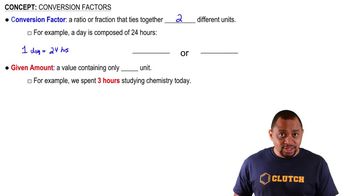
Concentration is often expressed in molarity (M), which is moles of solute per liter of solution. However, in this question, concentrations are provided in molecules per cubic centimeter (molecules/cm3). To calculate the reaction rate in M/s, it is necessary to convert these concentrations into molarity, using Avogadro's number (6.022x10^23 molecules/mol) to facilitate the conversion.
추천 영상:
가이드 코스
01:56
Conversion Factors