Ch.18 - Chemistry of the Environment
Brown - Chemistry: The Central Science 14th Edition
Brown14th EditionChemistry: The Central ScienceISBN: 9780134414232당신이 사용하는 게 아니라요?교과서 변경
18장, 문제 17a

The dissociation energy of a carbon-bromine bond is typically about 276 kJ/mol. (a) What is the maximum wavelength of photons that can cause C-Br bond dissociation?

검증된 단계별 안내
1
Step 1: Understand that the dissociation energy of a bond is the energy required to break that bond. In this case, we are given the dissociation energy of a carbon-bromine bond in kJ/mol. We need to convert this energy into Joules (J) because the formula we will use requires the energy in Joules. To do this, we use the conversion factor 1 kJ = 1000 J and 1 mol = 6.022 x 10^23 molecules (Avogadro's number).
Step 2: Use the formula for the energy of a photon, E = h * c / λ, where E is the energy, h is Planck's constant (6.626 x 10^-34 J*s), c is the speed of light (3.00 x 10^8 m/s), and λ is the wavelength. We are solving for λ, so we rearrange the formula to get λ = h * c / E.
Step 3: Substitute the values of h, c, and E (converted to Joules per molecule in step 1) into the formula. Remember to keep the units consistent, i.e., use Joules for energy, meters per second for the speed of light, and Joules*seconds for Planck's constant.
Step 4: Calculate the value of λ. This will give you the maximum wavelength of photons that can cause C-Br bond dissociation.
Step 5: Check your answer. The wavelength should be in the range of ultraviolet or visible light, as these are the types of light that typically have enough energy to break chemical bonds.

비슷한 문제에 대한 검증된 영상 답변:

이 영상 해법은 위 문제에 도움이 된다고 튜터들이 추천한 것입니다.
영상 길이:
5m

주요 개념

질문에 올바르게 답하기 위해 반드시 이해해야 하는 핵심 개념들은 다음과 같습니다.

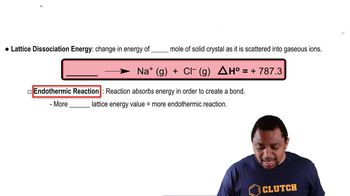
Dissociation Energy

Dissociation energy is the amount of energy required to break a bond between two atoms in a molecule. It is typically expressed in kilojoules per mole (kJ/mol) and indicates the strength of the bond; higher values correspond to stronger bonds. In this context, the dissociation energy of the carbon-bromine bond is 276 kJ/mol, which is crucial for determining the energy of photons needed for bond dissociation.
추천 영상:

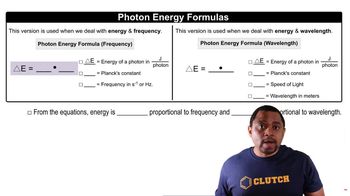
Photon Energy

Photon energy is the energy carried by a single photon, which can be calculated using the equation E = hν, where E is energy, h is Planck's constant (6.626 x 10^-34 J·s), and ν (nu) is the frequency of the photon. This relationship shows that the energy of a photon is directly proportional to its frequency and inversely proportional to its wavelength, allowing us to relate energy to wavelength using the equation λ = c/ν, where c is the speed of light.
추천 영상:
가이드 코스
01:40
Photon Energy Formulas

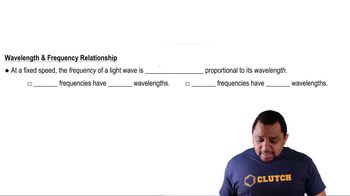
Wavelength and Energy Relationship

The relationship between wavelength and energy is fundamental in quantum chemistry. As the wavelength of light increases, its energy decreases, and vice versa. This inverse relationship is expressed in the equation E = hc/λ, where λ is the wavelength. To find the maximum wavelength that can cause C-Br bond dissociation, one must convert the dissociation energy from kJ/mol to joules per photon and then apply this equation to solve for λ.
추천 영상:
가이드 코스
00:31
Frequency-Wavelength Relationship