Ch.18 - Chemistry of the Environment
Brown - Chemistry: The Central Science 14th Edition
Brown14th EditionChemistry: The Central ScienceISBN: 9780134414232당신이 사용하는 게 아니라요?교과서 변경
18장, 문제 92

The pH of a particular raindrop is 5.6.
(a) Assuming the major species in the raindrop are H2CO3(aq), HCO3-(aq) and CO32- (aq), Calculate the concentrations of these species in the raindrop, assuming the total carbonate concentration is 1.0 * 10-5 M. The appropriate Ka values are given in Table 16.3.
(b) What experiments could you do to test the hypothesis that the rain also contains sulfur-containing species that contribute to its pH? Assume you have a large sample of rain to test.

검증된 단계별 안내
1
Step 1: Understand the problem and identify the given data. The pH of the raindrop is 5.6, and the total carbonate concentration is 1.0 \(\times\) 10^{-5} \(\text{ M}\). The species involved are \(\text{H}\)_2\(\text{CO}\)_3, \(\text{HCO}\)_3^-, and \(\text{CO}\)_3^{2-}.
Step 2: Use the pH to find the concentration of \(\text{H}\)^+ ions. Since \(\text{pH}\) = -\(\log\)[\(\text{H}\)^+], rearrange to find [\(\text{H}\)^+] = 10^{-\(\text{pH}\)}.
Step 3: Use the given \(\text{K}\)_a values for the dissociation of \(\text{H}\)_2\(\text{CO}\)_3 to \(\text{HCO}\)_3^- and \(\text{HCO}\)_3^- to \(\text{CO}\)_3^{2-}. Set up equilibrium expressions for each dissociation step using the \(\text{K}\)_a values.
Step 4: Apply the mass balance equation for the total carbonate concentration: [\(\text{H}\)_2\(\text{CO}\)_3] + [\(\text{HCO}\)_3^-] + [\(\text{CO}\)_3^{2-}] = 1.0 \(\times\) 10^{-5} \(\text{ M}\).
Step 5: Solve the system of equations from the equilibrium expressions and the mass balance to find the concentrations of \(\text{H}\)_2\(\text{CO}\)_3, \(\text{HCO}\)_3^-, and \(\text{CO}\)_3^{2-}.

비슷한 문제에 대한 검증된 영상 답변:

이 영상 해법은 위 문제에 도움이 된다고 튜터들이 추천한 것입니다.
영상 길이:
8m

주요 개념

질문에 올바르게 답하기 위해 반드시 이해해야 하는 핵심 개념들은 다음과 같습니다.

pH and Acid-Base Chemistry

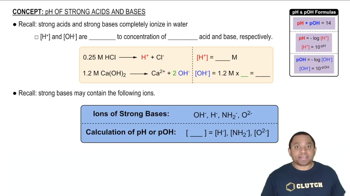
pH is a measure of the hydrogen ion concentration in a solution, indicating its acidity or basicity. A pH of 7 is neutral, while values below 7 indicate acidity and above 7 indicate basicity. In this context, a pH of 5.6 suggests the presence of acidic species, such as carbonic acid (H2CO3), which dissociates to release H+ ions, affecting the overall pH of the raindrop.
추천 영상:
가이드 코스
02:39
pH of Strong Acids and Bases

Equilibrium and Ka Values

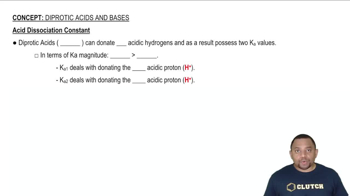
The acid dissociation constant (Ka) quantifies the strength of an acid in solution, representing the equilibrium between the undissociated acid and its ions. For the carbonate system, the relevant Ka values help determine the concentrations of H2CO3, HCO3-, and CO32- at a given pH. By applying the Henderson-Hasselbalch equation and the provided Ka values, one can calculate the concentrations of these species in the raindrop.
추천 영상:
가이드 코스
00:59
Ka values of Diprotic Acids

Experimental Methods for Analyzing Rain Composition

To investigate the presence of sulfur-containing species in rain, various analytical techniques can be employed, such as ion chromatography or mass spectrometry. These methods can detect and quantify ions like sulfate (SO4^2-) and bisulfate (HSO4-) that may influence the rain's pH. Additionally, titration experiments can help assess the acidity contributed by these species, providing insight into their role in the overall chemical composition of the rain.
추천 영상:
가이드 코스
05:50
Experimental Error