Consider the vaporization of liquid water to steam at a pressure of 1 atm. (d) At what temperature are the two phases in equilibrium?
Ch.19 - Chemical Thermodynamics
19장, 문제 15c
Consider the vaporization of liquid water to steam at a pressure of 1 atm. (c) In what temperature range is it a nonspontaneous process?
검증된 단계별 안내1
insert step 1> Identify the process: Vaporization of liquid water to steam at 1 atm pressure.
insert step 2> Recall that a process is nonspontaneous when the change in Gibbs free energy (ΔG) is positive.
insert step 3> Use the Gibbs free energy equation: ΔG = ΔH - TΔS, where ΔH is the enthalpy change, T is the temperature in Kelvin, and ΔS is the entropy change.
insert step 4> Recognize that at the boiling point of water (100°C or 373 K at 1 atm), ΔG = 0, meaning the process is at equilibrium.
insert step 5> Conclude that the process is nonspontaneous at temperatures below 100°C, where ΔG > 0, because the vaporization requires energy input to overcome intermolecular forces.

비슷한 문제에 대한 검증된 영상 답변:
이 영상 해법은 위 문제에 도움이 된다고 튜터들이 추천한 것입니다.
영상 길이:
1m주요 개념
질문에 올바르게 답하기 위해 반드시 이해해야 하는 핵심 개념들은 다음과 같습니다.
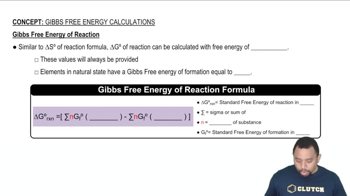
Gibbs Free Energy
Gibbs Free Energy (G) is a thermodynamic potential that helps predict the spontaneity of a process at constant temperature and pressure. A process is spontaneous if the change in Gibbs Free Energy (ΔG) is negative. For the vaporization of water, understanding how temperature affects ΔG is crucial in determining the conditions under which the process becomes nonspontaneous.
추천 영상:
가이드 코스
Gibbs Free Energy of Reactions
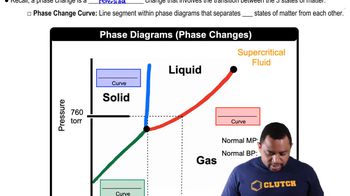
Phase Equilibrium
Phase equilibrium refers to the state where the rates of vaporization and condensation of a substance are equal, resulting in no net change in the amount of liquid and vapor. At 1 atm, water vaporizes at 100°C. Below this temperature, the equilibrium shifts towards the liquid phase, indicating that vaporization is nonspontaneous as the system favors condensation.
추천 영상:
가이드 코스
Phase Changes in Diagrams
Clausius-Clapeyron Equation
The Clausius-Clapeyron equation describes the relationship between the pressure and temperature of a substance during phase changes. It provides insight into how the vapor pressure of water changes with temperature, which is essential for understanding the conditions under which vaporization occurs. This equation helps identify the temperature range where vaporization is nonspontaneous by relating it to the pressure of the system.
추천 영상:
가이드 코스
Clausius-Clapeyron Equation
관련 실천
교과서 질문
790
views
교과서 질문
Consider the vaporization of liquid water to steam at a pressure of 1 atm. (b) In what temperature range is it a spontaneous process?
444
views
교과서 질문
(d) Does the amount of work that a system can do on its surroundings depend on the path of the process?
617
views
교과서 질문
The normal freezing point of n-octane (C8H18) is -57 °C. (b) In what temperature range is the freezing of n-octane a spontaneous process?
749
views
교과서 질문
Consider the vaporization of liquid water to steam at a pressure of 1 atm. (a) Is this process endothermic or exothermic?
655
views
교과서 질문
The normal freezing point of n-octane (C8H18) is -57 °C. (d) Is there any temperature at which liquid n-octane and solid n-octane are in equilibrium? Explain.
613
views