
Ch.19 - Chemical Thermodynamics
Brown - Chemistry: The Central Science 14th Edition
Brown14th EditionChemistry: The Central ScienceISBN: 9780134414232당신이 사용하는 게 아니라요?교과서 변경
19장, 문제 29b

For the isothermal expansion of a gas into a vacuum, ΔE = 0, q = 0, and w = 0. (b) Explain why no work is done by the system during this process.

검증된 단계별 안내
1
insert step 1> Understand the concept of isothermal expansion into a vacuum, which is also known as free expansion.
insert step 2> Recognize that in a vacuum, there is no external pressure opposing the expansion of the gas.
insert step 3> Recall that work done by a gas during expansion is given by the formula: w = -P_{ext} \(\Delta\) V, where P_{ext} is the external pressure.
insert step 4> Since the gas is expanding into a vacuum, P_{ext} = 0, meaning there is no opposing force.
insert step 5> Conclude that with P_{ext} = 0, the work done, w, is also 0, as w = -0 \(\times\) \(\Delta\) V = 0.

비슷한 문제에 대한 검증된 영상 답변:

이 영상 해법은 위 문제에 도움이 된다고 튜터들이 추천한 것입니다.
영상 길이:
2m

주요 개념

질문에 올바르게 답하기 위해 반드시 이해해야 하는 핵심 개념들은 다음과 같습니다.

Isothermal Process

An isothermal process occurs at a constant temperature, meaning that the internal energy of an ideal gas remains unchanged during the expansion or compression. In this scenario, since the temperature is constant, any heat added to the system is used to do work, but in the case of expansion into a vacuum, there is no heat exchange with the surroundings.
추천 영상:
가이드 코스
04:20
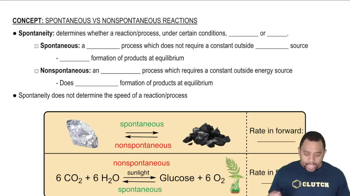
Spontaneity of Processes

Work in Thermodynamics

In thermodynamics, work is defined as the energy transfer that occurs when a force is applied over a distance. For a gas expanding against an external pressure, work is done by the system. However, in an expansion into a vacuum, there is no opposing pressure, meaning the gas does not push against anything, resulting in zero work done.
추천 영상:
가이드 코스
01:18
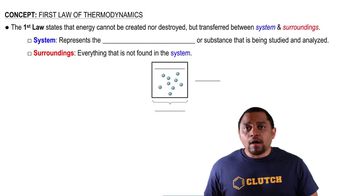
First Law of Thermodynamics

First Law of Thermodynamics

The First Law of Thermodynamics states that energy cannot be created or destroyed, only transformed. In the case of the isothermal expansion into a vacuum, the change in internal energy (ΔE) is zero, indicating that the energy remains constant. Since no work is done and no heat is exchanged, the system's energy balance confirms that ΔE = q + w = 0.
추천 영상:
가이드 코스
01:18
First Law of Thermodynamics