Ch.2 - Atoms, Molecules, and Ions
Brown - Chemistry: The Central Science 14th Edition
Brown14th EditionChemistry: The Central ScienceISBN: 9780134414232당신이 사용하는 게 아니라요?교과서 변경
2장, 문제 3a

Four of the boxes in the following periodic table are colored. Which of these are metals and which are nonmetals?

검증된 단계별 안내
1
insert step 1: Identify the location of the colored boxes on the periodic table.
insert step 2: Recall that metals are typically located on the left side and in the center of the periodic table, while nonmetals are found on the right side.
insert step 3: Check if the elements in the colored boxes are in groups known for metals, such as alkali metals, alkaline earth metals, transition metals, or post-transition metals.
insert step 4: Determine if any of the colored boxes are in groups known for nonmetals, such as the halogens or noble gases.
insert step 5: Classify each element in the colored boxes as either a metal or a nonmetal based on their position and group characteristics on the periodic table.

비슷한 문제에 대한 검증된 영상 답변:

이 영상 해법은 위 문제에 도움이 된다고 튜터들이 추천한 것입니다.
영상 길이:
1m

주요 개념

질문에 올바르게 답하기 위해 반드시 이해해야 하는 핵심 개념들은 다음과 같습니다.

Metals

Metals are elements that typically exhibit high electrical and thermal conductivity, malleability, ductility, and a shiny appearance. They are usually found on the left side and in the center of the periodic table. Common examples include iron, copper, and gold. Metals tend to lose electrons during chemical reactions, forming positive ions.
추천 영상:
가이드 코스
03:12
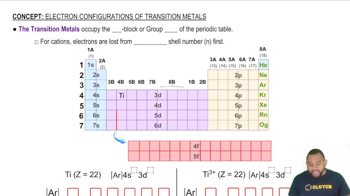
Transition Metals

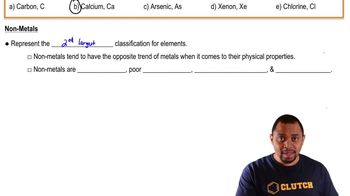
Nonmetals

Nonmetals are elements that generally lack the properties of metals and are found on the right side of the periodic table. They are poor conductors of heat and electricity, and they can be gases, liquids, or solids at room temperature. Nonmetals tend to gain or share electrons in chemical reactions, forming negative ions or covalent bonds. Examples include oxygen, nitrogen, and sulfur.
추천 영상:
가이드 코스
01:12
Nonmetal Properties

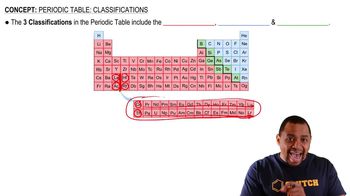
Periodic Table Classification

The periodic table classifies elements based on their atomic number, electron configuration, and recurring chemical properties. Elements are organized into groups (columns) and periods (rows), with metals on the left, nonmetals on the right, and metalloids in between. This classification helps predict the behavior of elements in chemical reactions and their physical properties.
추천 영상:
가이드 코스
02:40
Periodic Table Classifications