Ch.2 - Atoms, Molecules, and Ions
Brown - Chemistry: The Central Science 14th Edition
Brown14th EditionChemistry: The Central ScienceISBN: 9780134414232당신이 사용하는 게 아니라요?교과서 변경
2장, 문제 70e

Give the names and charges of the cation and anion in each of the following compounds: (e) PbCO3.

검증된 단계별 안내
1
Identify the chemical formula: PbCO_3.
Determine the cation in the compound: Pb (lead).
Determine the anion in the compound: CO_3 (carbonate).
Identify the charge of the carbonate ion: CO_3^{2-}.
Determine the charge of the lead cation by balancing the charges: Pb^{2+}.

비슷한 문제에 대한 검증된 영상 답변:

이 영상 해법은 위 문제에 도움이 된다고 튜터들이 추천한 것입니다.
영상 길이:
3m

주요 개념

질문에 올바르게 답하기 위해 반드시 이해해야 하는 핵심 개념들은 다음과 같습니다.

Ionic Compounds

Ionic compounds are formed when cations (positively charged ions) and anions (negatively charged ions) bond together through electrostatic forces. In these compounds, the total positive charge from the cations must balance the total negative charge from the anions, resulting in a neutral overall charge for the compound.
추천 영상:
가이드 코스
02:11
Ionic Compounds Naming

Common Ions

Common ions are specific ions that frequently occur in various compounds. For example, lead (Pb) can form a cation with a charge of +2 (Pb²⁺), while carbonate (CO3) is a common anion with a charge of -2 (CO3²⁻). Recognizing these common ions is essential for identifying the components of ionic compounds.
추천 영상:
가이드 코스
02:53
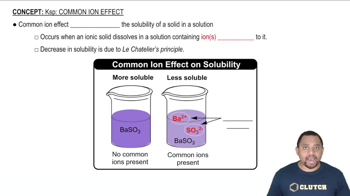
Common Ion Effect

Charge Balance

Charge balance is a fundamental principle in chemistry that states the total positive charge must equal the total negative charge in a neutral compound. When determining the cation and anion in a compound like PbCO3, it is crucial to ensure that the charges of the ions combine to yield a neutral compound, guiding the identification of the correct ions.
추천 영상: