A laboratory rat is exposed to an alpha-radiation source whose activity is 14.3 mCi. (a) What is the activity of the radiation in disintegrations per second? In becquerels?
Ch.21 - Nuclear Chemistry
21장, 문제 71a
The table to the right gives the number of protons (p) and neutrons (n) for four isotopes. (a) Write the symbol for each of the isotopes.
검증된 단계별 안내1
Identify the element by its number of protons. The atomic number, which is the number of protons, determines the element. For example, if an isotope has 6 protons, it corresponds to Carbon (C).
Determine the mass number of each isotope. The mass number is the sum of the number of protons and neutrons in the nucleus. For instance, if an isotope has 6 protons and 8 neutrons, its mass number is 14.
Write the symbol for each isotope using the format: \\( ^{mass\ number}_{atomic\ number}Element \\). For the example above with Carbon, the symbol would be \\( ^{14}_6C \\).
Repeat the process for each isotope listed in the table, ensuring to use the correct atomic number and mass number for each.
Review the symbols to ensure they correctly represent the isotopes as per the data given in the table regarding the number of protons and neutrons.

비슷한 문제에 대한 검증된 영상 답변:
이 영상 해법은 위 문제에 도움이 된다고 튜터들이 추천한 것입니다.
영상 길이:
2m주요 개념
질문에 올바르게 답하기 위해 반드시 이해해야 하는 핵심 개념들은 다음과 같습니다.
Isotopes
Isotopes are variants of a particular chemical element that have the same number of protons but different numbers of neutrons. This difference in neutron count results in varying atomic masses for the isotopes of the same element. For example, carbon-12 and carbon-14 are isotopes of carbon, with 6 protons and 6 or 8 neutrons, respectively.
추천 영상:
가이드 코스
Isotopes
Nuclear Symbol Notation
Nuclear symbol notation is a way to represent isotopes using the element's symbol along with its mass number and atomic number. The mass number (total number of protons and neutrons) is written as a superscript to the left of the element symbol, while the atomic number (number of protons) is written as a subscript. For instance, the notation for carbon-14 is written as ¹⁴₆C.
추천 영상:
가이드 코스
Standard Notation to Scientific Notation
Atomic Structure
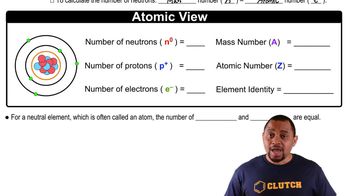
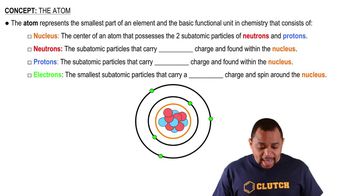
Atomic structure refers to the arrangement of protons, neutrons, and electrons within an atom. Protons and neutrons reside in the nucleus, while electrons orbit around the nucleus in electron shells. Understanding atomic structure is essential for identifying isotopes, as it helps clarify how variations in neutron numbers affect the overall properties of the element.
추천 영상:
가이드 코스
Atom Structure
관련 실천
교과서 질문
512
views
교과서 질문
Radon-222 decays to a stable nucleus by a series of three alpha emissions and two beta emissions. What is the stable nucleus that is formed?
1435
views
교과서 질문
A laboratory rat is exposed to an alpha-radiation source whose activity is 14.3 mCi. (b) The rat has a mass of 385 g and is exposed to the radiation for 14.0 s, absorbing 35% of the emitted alpha particles, each having an energy of 9.12 * 10-13 J. Calculate the absorbed dose in millirads and grays.
99
views
교과서 질문
Chlorine has two stable nuclides, 35Cl and 37Cl. In contrast, 36Cl is a radioactive nuclide that decays by beta emission. (a) What is the product of decay of 36Cl?
464
views