Ch.23 - Transition Metals and Coordination Chemistry
Brown - Chemistry: The Central Science 14th Edition
Brown14th EditionChemistry: The Central ScienceISBN: 9780134414232당신이 사용하는 게 아니라요?교과서 변경
23장, 문제 15b

Write out the ground-state electron configurations of b. Ru²⁺

검증된 단계별 안내
1
Identify the atomic number of Ruthenium (Ru) from the periodic table. The atomic number tells you the number of protons and, in a neutral atom, the number of electrons.
Write the electron configuration for a neutral Ruthenium atom. Ruthenium is in the 4d block of the periodic table, so its electrons will fill the 4d orbital after the 4s and 4p orbitals.
Remove electrons to account for the 2+ charge of Ru²⁺. Electrons are removed from the outermost orbitals first, typically starting from the highest energy level orbital.
Rearrange the remaining electrons to reflect the electron configuration of Ru²⁺, ensuring that the orbitals are filled according to Hund's Rule (maximum multiplicity) and the Pauli Exclusion Principle (no two electrons in the same atom can have the same four quantum numbers).
Verify the electron configuration by ensuring the total number of electrons equals the atomic number of Ruthenium minus the charge (44 - 2 = 42 electrons).

비슷한 문제에 대한 검증된 영상 답변:

이 영상 해법은 위 문제에 도움이 된다고 튜터들이 추천한 것입니다.
영상 길이:
1m

주요 개념

질문에 올바르게 답하기 위해 반드시 이해해야 하는 핵심 개념들은 다음과 같습니다.

Electron Configuration

Electron configuration describes the distribution of electrons in an atom's orbitals. It follows the Aufbau principle, which states that electrons fill orbitals starting from the lowest energy level to the highest. The notation typically includes the principal quantum number, the type of orbital, and the number of electrons in that orbital, such as 1s² 2s² 2p⁶.
추천 영상:
가이드 코스
01:33
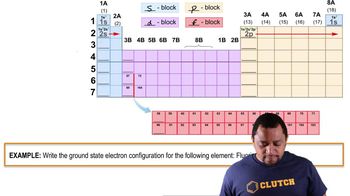
Electron Configuration Example

Transition Metals

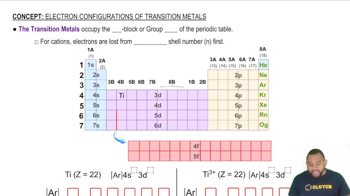
Transition metals are elements found in the d-block of the periodic table, characterized by their ability to form variable oxidation states and colored compounds. They have partially filled d orbitals, which play a crucial role in their chemical properties and electron configurations. Understanding their electron configurations is essential for predicting their behavior in chemical reactions.
추천 영상:
가이드 코스
03:12
Transition Metals

Oxidation States

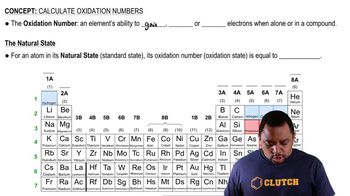
Oxidation states indicate the degree of oxidation of an atom in a compound, reflecting the number of electrons lost, gained, or shared. For example, in the case of Ru²⁺, the oxidation state of +2 means that the ruthenium atom has lost two electrons compared to its neutral state. This change affects its electron configuration, as electrons are removed from the highest energy orbitals.
추천 영상:
가이드 코스
02:42
Oxidation Numbers