Ch.3 - Chemical Reactions and Reaction Stoichiometry
Brown - Chemistry: The Central Science 14th Edition
Brown14th EditionChemistry: The Central ScienceISBN: 9780134414232당신이 사용하는 게 아니라요?교과서 변경
3장, 문제 112

A 3.50 g of an alloy which contains only lead and tin is dissolved in hot HNO3. Excess sulfuric acid is added to this solution and 1.57g of PbSO4(s) is obtained. (b) Assuming all the lead in the alloy reacted to form PbSO4, what was the amount, in grams, of lead and tin in the alloy respectively?

검증된 단계별 안내
1
Identify the chemical reaction: Lead (Pb) reacts with sulfuric acid (H2SO4) to form lead sulfate (PbSO4).
Use the mass of PbSO4 obtained (1.57 g) to calculate the moles of PbSO4 using its molar mass.
Since the stoichiometry of the reaction is 1:1, the moles of PbSO4 will be equal to the moles of Pb in the alloy.
Convert the moles of Pb to grams using the molar mass of lead.
Subtract the mass of lead from the total mass of the alloy to find the mass of tin.

비슷한 문제에 대한 검증된 영상 답변:

이 영상 해법은 위 문제에 도움이 된다고 튜터들이 추천한 것입니다.
영상 길이:
5m

주요 개념

질문에 올바르게 답하기 위해 반드시 이해해야 하는 핵심 개념들은 다음과 같습니다.

Stoichiometry

Stoichiometry is the calculation of reactants and products in chemical reactions based on the conservation of mass. It involves using balanced chemical equations to determine the relationships between the amounts of substances consumed and produced. In this question, stoichiometry is essential for relating the mass of PbSO4 produced to the mass of lead in the original alloy.
추천 영상:
가이드 코스
01:16
Stoichiometry Concept

Molar Mass

Molar mass is the mass of one mole of a substance, typically expressed in grams per mole (g/mol). It is crucial for converting between the mass of a substance and the number of moles, which allows for stoichiometric calculations. For this problem, knowing the molar masses of lead (Pb) and tin (Sn) will help determine the amounts of each metal in the alloy.
추천 영상:
가이드 코스
02:11
Molar Mass Concept

Chemical Reactions and Precipitation

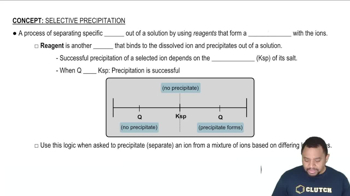
Chemical reactions involve the transformation of reactants into products, and precipitation occurs when a solid forms from a solution. In this scenario, the formation of PbSO4 as a precipitate indicates that lead from the alloy reacted with sulfate ions. Understanding this process is key to determining how much lead was present in the original alloy based on the mass of the precipitate formed.
추천 영상:
가이드 코스
01:53
Selective Precipitation
관련 실천
교과서 질문

(b) Because atoms are spherical, they cannot occupy all of the space of the cube. The silver atoms pack in the solid in such a way that 74% of the volume of the solid is actually filled with the silver atoms. Calculate the volume of a single silver atom.

교과서 질문

Hydrogen cyanide, HCN, is a poisonous gas. The lethal dose is approximately 300 mg HCN per kilogram of air when inhaled. (a) Calculate the amount of HCN that gives the lethal dose in a small laboratory room measuring 3.5 × 4.5 × 2.5 m. The density of air at 26 °C is 0.00118 g/cm3. (b) If the HCN is formed by reaction of NaCN with an acid such as H2SO4, what mass of NaCN gives the lethal dose in the room? 2 NaCN(s) + H2SO4(aq) → Na2SO4(aq) + 2 HCN(g)

1533
views
교과서 질문

Hydrogen cyanide, HCN, is a poisonous gas. The lethal dose is approximately 300 mg HCN per kilogram of air when inhaled. (c) HCN forms when synthetic fibers containing Orlon® or Acrilan ® burn. Acrilan® has an empirical formula of CH2CHCN, so HCN is 50.9% of the formula by mass. A rug measures 3.5 × 4.5 m and contains 850 g of Acrilan® fibers per square yard of carpet. If the rug burns, will a lethal dose of HCN be generated in the room? Assume that the yield of HCN from the fibers is 20% and that the carpet is 50% consumed.

1268
views
교과서 질문

The source of oxygen that drives the internal combustion engine in an automobile is air. Air is a mixture of gases, principally N2(79%) and O2(20%). In the cylinder of an automobile engine, nitrogen can react with oxygen to produce nitric oxide gas, NO. As NO is emitted from the tailpipe of the car, it can react with more oxygen to produce nitrogen dioxide gas. (a) Write balanced chemical equations for both reactions.

교과서 질문

Burning acetylene in oxygen can produce three different carbon-containing products: soot (very fine particles of graphite), CO(g), and CO2(g). (c) Why, when the oxygen supply is adequate, is CO2(g) the predominant carbon-containing product of the combustion of acetylene?

1216
views