Ch.3 - Chemical Reactions and Reaction Stoichiometry
Brown - Chemistry: The Central Science 14th Edition
Brown14th EditionChemistry: The Central ScienceISBN: 9780134414232당신이 사용하는 게 아니라요?교과서 변경
3장, 문제 56a

(a) The characteristic odor of pineapple is due to ethyl butyrate, a compound containing carbon, hydrogen, and oxygen. Combustion of 2.78 mg of ethyl butyrate produces 6.32 mg of CO2 and 2.58 mg of H2O. What is the empirical formula of the compound?

검증된 단계별 안내
1
Determine the mass of carbon in the CO2 produced. Use the molar mass of CO2 (44.01 g/mol) and the fact that each mole of CO2 contains one mole of carbon atoms.
Calculate the mass of hydrogen in the H2O produced. Use the molar mass of H2O (18.02 g/mol) and the fact that each mole of H2O contains two moles of hydrogen atoms.
Subtract the mass of carbon and hydrogen from the total mass of ethyl butyrate combusted to estimate the mass of oxygen in the ethyl butyrate.
Convert the masses of carbon, hydrogen, and oxygen to moles by dividing each by their respective atomic masses (C: 12.01 g/mol, H: 1.008 g/mol, O: 16.00 g/mol).
Divide the moles of each element by the smallest number of moles to find the simplest whole number ratio of atoms of each element, which gives the empirical formula.

비슷한 문제에 대한 검증된 영상 답변:

이 영상 해법은 위 문제에 도움이 된다고 튜터들이 추천한 것입니다.

주요 개념

질문에 올바르게 답하기 위해 반드시 이해해야 하는 핵심 개념들은 다음과 같습니다.

Empirical Formula

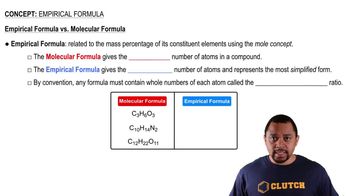
The empirical formula of a compound represents the simplest whole-number ratio of the elements present in that compound. It is derived from the relative amounts of each element, typically expressed in terms of moles. For example, if a compound contains carbon, hydrogen, and oxygen in a ratio of 1:2:1, its empirical formula would be CH2O.
추천 영상:
가이드 코스
02:26
Empirical vs Molecular Formula

Combustion Analysis

Combustion analysis is a method used to determine the composition of organic compounds by burning them in excess oxygen. The products of combustion, typically carbon dioxide (CO2) and water (H2O), are measured to calculate the amounts of carbon and hydrogen in the original compound. This technique is essential for deriving the empirical formula from the mass of the combustion products.
추천 영상:
가이드 코스
01:29
Combustion of Non-Hydrocarbons

Stoichiometry

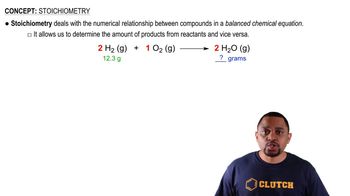
Stoichiometry is the area of chemistry that deals with the quantitative relationships between the reactants and products in a chemical reaction. It allows chemists to calculate the amounts of substances consumed and produced in a reaction based on balanced chemical equations. Understanding stoichiometry is crucial for converting mass measurements into moles and determining the empirical formula from experimental data.
추천 영상:
가이드 코스
01:16
Stoichiometry Concept
관련 실천
교과서 질문

Valproic acid, used to treat seizures and bipolar disorder, is composed of C, H, and O. A 0.165-g sample is combusted to produce 0.166 g of water and 0.403 g of carbon dioxide. What is the empirical formula for valproic acid?

919
views

교과서 질문

Propenoic acid, C3H4O2, is a reactive organic liquid that is used in the manufacturing of plastics, coatings, and adhesives. An unlabeled container is thought to contain this liquid. A 0.275-g sample of the liquid is combusted to produce 0.102 g of water and 0.374 g carbon dioxide. Is the unknown liquid propenoic acid? Support your reasoning with calculations.

2291
views
교과서 질문

(a) Combustion analysis of toluene, a common organic solvent, gives 5.86 mg of CO2 and 1.37 mg of H2O. If the compound contains only carbon and hydrogen, what is its empirical formula?

1692
views
교과서 질문

(b) Menthol, the substance we can smell in mentholated cough drops, is composed of C, H, and O. A 0.1005-g sample of menthol is combusted, producing 0.2829 g of CO2 and 0.1159 g of H2O. What is the empirical formula for menthol? If menthol has a molar mass of 156 g/mol, what is its molecular formula?

2103
views
교과서 질문

Determine the empirical and molecular formulas of each of the following substances: (c) Epinephrine (adrenaline), a hormone secreted into the bloodstream in times of danger or stress, contains 59.0% C, 7.1% H, 26.2% O, and 7.7% N by mass; its molar mass is about 180 u.

1228
views
교과서 질문

(b) Nicotine, a component of tobacco, is composed of C, H, and N. A 5.250-mg sample of nicotine was combusted, producing 14.242 mg of CO2 and 4.083 mg of H2O. What is the empirical formula for nicotine? If nicotine has a molar mass of 160 ± 5 g/mol, what is its molecular formula?

2292
views