Ch.3 - Chemical Reactions and Reaction Stoichiometry
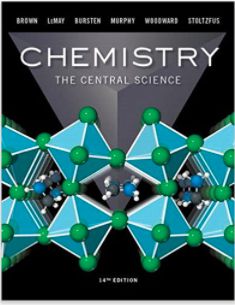
Brown - Chemistry: The Central Science 14th Edition
Brown14th EditionChemistry: The Central ScienceISBN: 9780134414232당신이 사용하는 게 아니라요?교과서 변경
3장, 문제 24

Determine the formula weights of each of the following compounds: (a) Butyric acid, CH3CH2CH2COOH, which is responsible for the rotten smell of spoiled food (b) sodium perborate, NaBO3, a substance used as bleach (c) CF2Cl2, a refrigerant known as Freon (d) NaHCO3, known as baking soda and used in bread and pastry baking (e) isopentyl acetate, CH3CO2C5H11, responsible for the odor of bananas.

검증된 단계별 안내
1
Identify the elements and their respective counts in the molecular formula of isopentyl acetate, CH3CO2C5H11. The formula can be broken down as: 2 Carbon atoms from the acetyl group (CH3CO), 5 Carbon atoms and 11 Hydrogen atoms from the pentyl group (C5H11), and 2 Oxygen atoms from the acetate group (CO2).
Calculate the total number of each type of atom in the compound: Carbon atoms = 2 (from acetyl) + 5 (from pentyl) = 7, Hydrogen atoms = 3 (from acetyl) + 11 (from pentyl) = 14, Oxygen atoms = 2 (from acetate).
Look up the atomic weights for each element from the periodic table: Carbon (C) approximately 12.01 amu, Hydrogen (H) approximately 1.008 amu, and Oxygen (O) approximately 16.00 amu.
Multiply the atomic weight of each element by the number of atoms of that element in the compound: Carbon contribution = 7 atoms × 12.01 amu, Hydrogen contribution = 14 atoms × 1.008 amu, Oxygen contribution = 2 atoms × 16.00 amu.
Add up all the contributions to get the total formula weight of isopentyl acetate: Total formula weight = Carbon contribution + Hydrogen contribution + Oxygen contribution.

비슷한 문제에 대한 검증된 영상 답변:

이 영상 해법은 위 문제에 도움이 된다고 튜터들이 추천한 것입니다.
영상 길이:
1m

주요 개념

질문에 올바르게 답하기 위해 반드시 이해해야 하는 핵심 개념들은 다음과 같습니다.

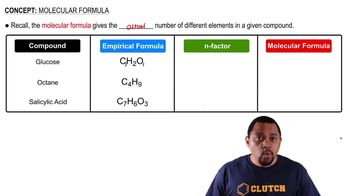
Molecular Formula

The molecular formula of a compound indicates the number and types of atoms present in a molecule. For isopentyl acetate, the formula is CH3CO2C5H11, which shows it contains carbon (C), hydrogen (H), and oxygen (O) atoms. Understanding how to interpret molecular formulas is essential for calculating formula weights.
추천 영상:
가이드 코스
02:08
Determining Molecular Formulas

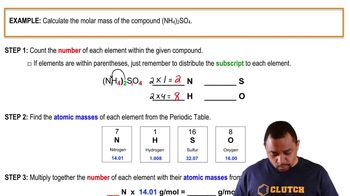
Molar Mass Calculation

Molar mass is the mass of one mole of a substance, calculated by summing the atomic masses of all atoms in the molecular formula. Each element's atomic mass can be found on the periodic table. For isopentyl acetate, you would multiply the number of each type of atom by its atomic mass and then sum these values to find the total formula weight.
추천 영상:
가이드 코스
03:12
Molar Mass Calculation Example

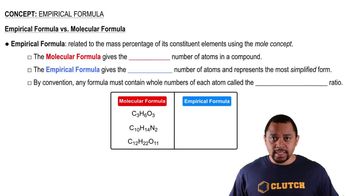
Empirical vs. Molecular Formula

The empirical formula represents the simplest whole-number ratio of atoms in a compound, while the molecular formula shows the actual number of atoms. In the case of isopentyl acetate, understanding the difference helps in recognizing that the molecular formula provides more detailed information about the compound's structure and composition, which is crucial for accurate weight calculations.
추천 영상:
가이드 코스
02:26
Empirical vs Molecular Formula