


Ch.3 - Chemical Reactions and Reaction Stoichiometry
Brown - Chemistry: The Central Science 14th Edition
Brown14th EditionChemistry: The Central ScienceISBN: 9780134414232당신이 사용하는 게 아니라요?교과서 변경
3장, 문제 80c

One of the steps in the commercial process for converting ammonia to nitric acid is the conversion of NH3 to NO: 4 NH31g2 + 5 O21g2¡4 NO1g2 + 6 H2O1g2 In a certain experiment, 2.00 g of NH3 reacts with 2.50 g of O2. (c) How many grams of the excess reactant remain after the limiting reactant is completely consumed?

검증된 단계별 안내
1
Step 1: Write down the balanced chemical equation. In this case, it is already provided: 4 NH3(g) + 5 O2(g) → 4 NO(g) + 6 H2O(g).
Step 2: Convert the masses of NH3 and O2 given in the problem to moles. You can do this by dividing the given mass by the molar mass of each compound. The molar mass of NH3 is approximately 17.03 g/mol and the molar mass of O2 is approximately 32.00 g/mol.
Step 3: Determine the limiting reactant. This is the reactant that will be completely consumed first in the reaction. You can do this by comparing the mole ratio of the reactants from the balanced chemical equation with the mole ratio of the reactants you have. The reactant with the smaller ratio is the limiting reactant.
Step 4: Calculate the amount of the excess reactant that is consumed. You can do this by using the stoichiometry of the reaction from the balanced chemical equation. Multiply the moles of the limiting reactant by the ratio of the moles of the excess reactant to the moles of the limiting reactant from the balanced chemical equation.
Step 5: Subtract the amount of the excess reactant that is consumed from the initial amount of the excess reactant. This will give you the amount of the excess reactant that remains after the reaction. Convert this amount from moles back to grams by multiplying by the molar mass of the excess reactant.

비슷한 문제에 대한 검증된 영상 답변:

이 영상 해법은 위 문제에 도움이 된다고 튜터들이 추천한 것입니다.
영상 길이:
4m

주요 개념

질문에 올바르게 답하기 위해 반드시 이해해야 하는 핵심 개념들은 다음과 같습니다.

Limiting Reactant

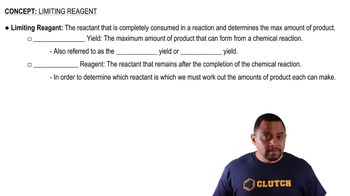
The limiting reactant is the substance that is completely consumed first in a chemical reaction, thus determining the maximum amount of product that can be formed. In this scenario, identifying the limiting reactant is crucial to calculate how much of the other reactant remains after the reaction has occurred.
추천 영상:
가이드 코스
01:30
Limiting Reagent Concept

Stoichiometry

Stoichiometry involves the calculation of reactants and products in chemical reactions based on balanced equations. It allows us to determine the mole ratios of the reactants and products, which is essential for finding out how much of each reactant is used and how much remains after the reaction.
추천 영상:
가이드 코스
01:16
Stoichiometry Concept

Molar Mass

Molar mass is the mass of one mole of a substance, typically expressed in grams per mole. To solve the problem, it is necessary to convert the given masses of NH3 and O2 into moles using their respective molar masses, which will facilitate the stoichiometric calculations needed to identify the limiting reactant and the excess remaining.
추천 영상:
가이드 코스
02:11
Molar Mass Concept
관련 실천
교과서 질문

Solutions of sodium carbonate and silver nitrate react to form solid silver carbonate and a solution of sodium nitrate. A solution containing 3.50 g of sodium carbonate is mixed with one containing 5.00 g of silver nitrate. How many grams of sodium carbonate are present after the reaction is complete? How many grams of sodium nitrate are present after the reaction is complete?

1557
views
1
rank
교과서 질문

Aluminum hydroxide reacts with sulfuric acid as follows: 2 Al1OH231s2 + 3 H2SO41aq2¡Al21SO4231aq2 + 6 H2O1l2 How many moles of the excess reactant remain after the completion of the reaction?

624
views
교과서 질문

One of the steps in the commercial process for converting ammonia to nitric acid is the conversion of NH3 to NO: 4 NH3(g) + 5 O2(g) → 4 NO(g) + 6 H2O(g) In a certain experiment, 2.00 g of NH3 reacts with 2.50 g of O2. (d) Show that your calculations in parts (b) and (c) are consistent with the law of conservation of mass.

2103
views
교과서 질문

One of the steps in the commercial process for converting ammonia to nitric acid is the conversion of NH3 to NO: 4 NH31g2 + 5 O21g2¡4 NO1g2 + 6 H2O1g2 In a certain experiment, 2.00 g of NH3 reacts with 2.50 g of O2. (a) Which is the limiting reactant?

566
views
1
comments
교과서 질문

Solutions of sodium carbonate and silver nitrate react to form solid silver carbonate and a solution of sodium nitrate. A solution containing 3.50 g of sodium carbonate is mixed with one containing 5.00 g of silver nitrate. How many grams of silver carbonate are present after the reaction is complete?

3918
views
교과서 질문

The fizz produced when an Alka-Seltzer tablet is dissolved in water is due to the reaction between sodium bicarbonate 1NaHCO32 and citric acid 1H3C6H5O72: 3 NaHCO31aq2 + H3C6H5O71aq2¡ 3 CO21g2 + 3H2O1l2 + Na3C6H5O71aq2 In a certain experiment 1.00 g of sodium bicarbonate and 1.00 g of citric acid are allowed to react. (a) Which is the limiting reactant? (b) How many grams of carbon dioxide form? (c) How many grams of the excess reactant remain after the limiting reactant is completely consumed?

1068
views
1
comments