

Ch.3 - Chemical Reactions and Reaction Stoichiometry
Brown - Chemistry: The Central Science 14th Edition
Brown14th EditionChemistry: The Central ScienceISBN: 9780134414232당신이 사용하는 게 아니라요?교과서 변경
3장, 문제 68c

The complete combustion of octane, C8H18, a component of gasoline, proceeds as follows: 2 C8H18 (l) + 25 O2 (g) → 16 CO2 (g) + 18 H2O (g) (c) Octane has a density of 0.692 g/mL at 20 °C. How many grams of O2 are required to burn 15.0 gal of C8H18 (the capacity of an average fuel tank)?

검증된 단계별 안내
1
Convert the volume of octane from gallons to milliliters using the conversion factor: 1 gallon = 3,785.41 mL.
Calculate the mass of octane using its density: mass = volume x density.
Use the balanced chemical equation to determine the molar ratio between octane (C_8H_18) and oxygen (O_2).
Calculate the moles of octane using its molar mass: moles = mass / molar mass.
Use the molar ratio to find the moles of O_2 required, then convert moles of O_2 to grams using the molar mass of O_2.

비슷한 문제에 대한 검증된 영상 답변:

이 영상 해법은 위 문제에 도움이 된다고 튜터들이 추천한 것입니다.

주요 개념

질문에 올바르게 답하기 위해 반드시 이해해야 하는 핵심 개념들은 다음과 같습니다.

Stoichiometry

Stoichiometry is the calculation of reactants and products in chemical reactions based on the balanced chemical equation. It allows us to determine the proportions of substances involved in a reaction, which is essential for converting quantities of one substance to another. In this case, stoichiometry will help us find the amount of oxygen needed to completely combust a given volume of octane.
추천 영상:
가이드 코스
01:16
Stoichiometry Concept

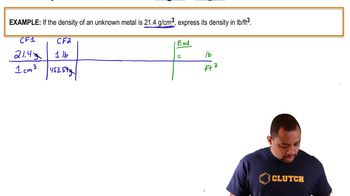
Density and Volume Conversion

Density is defined as mass per unit volume and is crucial for converting between the volume of a liquid and its mass. In this problem, the density of octane (0.692 g/mL) will be used to convert the volume of octane (15.0 gallons) into grams. Understanding how to convert between different units of measurement is essential for solving problems in chemistry.
추천 영상:
가이드 코스
05:30
Density Conversion Example

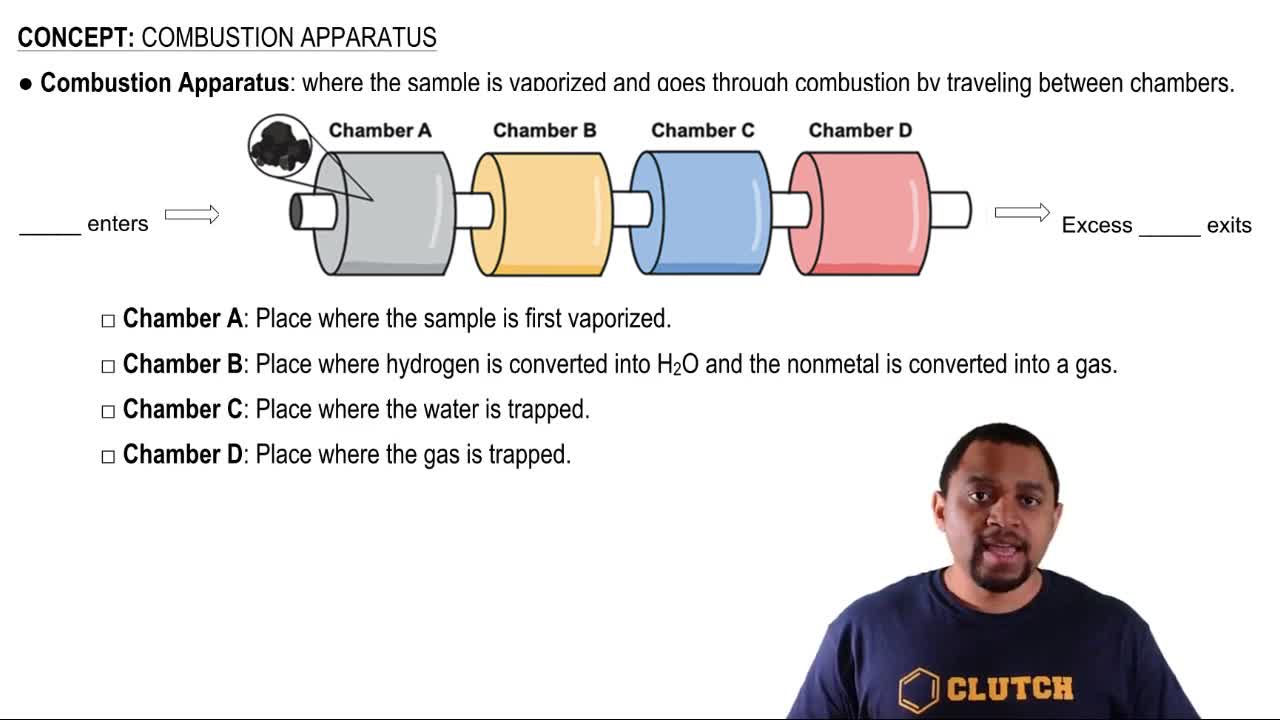
Combustion Reaction

A combustion reaction is a chemical process in which a substance reacts with oxygen to produce heat and light, typically resulting in carbon dioxide and water as products. The complete combustion of octane is represented by the provided balanced equation, which indicates the specific molar ratios of octane and oxygen required. Recognizing the nature of combustion reactions is vital for understanding the energy release and reactant requirements in this scenario.
추천 영상:
가이드 코스
02:24
Combustion Apparatus