Vanillin, the dominant flavoring in vanilla, contains C, H, and O. When 1.05 g of this substance is completely combusted, 2.43 g of CO2 and 0.50 g of H2O are produced. What is the empirical formula of vanillin?
Ch.3 - Chemical Reactions and Reaction Stoichiometry
3장, 문제 94
The fluoride ion reacts with water to produce HF. (a) Write out the chemical equation for this reaction.
검증된 단계별 안내1
Step 1: Identify the reactants and products. In this case, the reactants are the fluoride ion (F-) and water (H2O). The product is hydrofluoric acid (HF).
Step 2: Write the chemical equation with the reactants on the left and the products on the right. The arrow in the middle represents the direction of the reaction. So, the initial equation would look like this: F- + H2O -> HF
Step 3: Balance the equation. In this case, the equation is already balanced, as there is one atom of each element on both sides of the equation.
Step 4: Include the state of each substance. In this case, the fluoride ion is in aqueous solution (aq), water is a liquid (l), and hydrofluoric acid is also in aqueous solution (aq). So, the final balanced chemical equation is: F-(aq) + H2O(l) -> HF(aq)
Step 5: Note that this is a simplified version of the reaction. In reality, the fluoride ion reacts with water to produce hydrofluoric acid and a hydroxide ion (OH-), so the complete balanced equation would be: F-(aq) + H2O(l) -> HF(aq) + OH-(aq)

비슷한 문제에 대한 검증된 영상 답변:
이 영상 해법은 위 문제에 도움이 된다고 튜터들이 추천한 것입니다.
영상 길이:
2m주요 개념
질문에 올바르게 답하기 위해 반드시 이해해야 하는 핵심 개념들은 다음과 같습니다.
Chemical Reactions
A chemical reaction involves the transformation of reactants into products through the breaking and forming of chemical bonds. In this case, the fluoride ion (F-) reacts with water (H2O) to form hydrofluoric acid (HF). Understanding the nature of reactants and products is essential for writing balanced chemical equations.
추천 영상:
가이드 코스
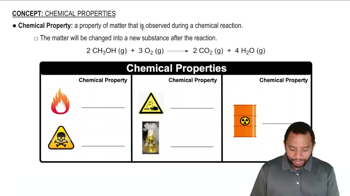
Chemical Properties
Ionic and Molecular Compounds
Fluoride ion (F-) is an example of an ionic species, while hydrofluoric acid (HF) is a molecular compound. Ionic compounds typically form from the transfer of electrons between metals and nonmetals, while molecular compounds result from the sharing of electrons. Recognizing the difference helps in predicting the behavior of substances in reactions.
추천 영상:
가이드 코스
Ionic Compounds Naming
Acid-Base Chemistry
The reaction of fluoride ion with water can be understood through the lens of acid-base chemistry, where HF acts as a weak acid. In this context, water can act as a base, accepting a proton (H+) from HF. This concept is crucial for understanding the properties of acids and bases in aqueous solutions.
추천 영상:
가이드 코스
Arrhenius Acids and Bases
관련 실천
교과서 질문
1337
views
교과서 질문
Cinnamaldehyde is a compound that is responsible for the
characteristic aroma of cinnamon. It contains 81.79% C,
6.10% H, and the remaining is oxygen. Its molar mass is
132 g/mol. Determine its molecular formula.
1607
views
교과서 질문
An organic compound was found to contain only C, H, and Cl. When a 1.50-g sample of the compound was completely combusted in air, 3.52 g of CO2 was formed. In a separate experiment, the chlorine in a 1.00-g sample of the compound was converted to 1.27 g of AgCl. Determine the empirical formula of the compound.
2587
views
2
rank
교과서 질문
(a) One molecule of the antibiotic penicillin G has a mass of 5.342×10⁻²¹ g. What is the molar mass of penicillin G?
교과서 질문
(b) Hemoglobin, the oxygen-carrying protein in red blood cells, has four iron atoms per molecule and contains 0.340% iron by mass. Calculate the molar mass of hemoglobin.
1609
views
교과서 질문
A compound, Na2Cr2Ox, where x is unknown, is analyzed
and found to contain 39.70% Cr. What is the value of x?
393
views