

Ch.3 - Chemical Reactions and Reaction Stoichiometry
Brown - Chemistry: The Central Science 14th Edition
Brown14th EditionChemistry: The Central ScienceISBN: 9780134414232당신이 사용하는 게 아니라요?교과서 변경
3장, 문제 105c1

When a mixture of 10.0 g of acetylene (C2H2) and 10.0 g of oxygen (O2) is ignited, the resulting combustion reaction produces CO2 and H2O. (c) How many grams of C2H2 are present after the reaction is complete?

검증된 단계별 안내
1
Identify the balanced chemical equation for the combustion of acetylene: \( 2 \text{C}_2\text{H}_2 + 5 \text{O}_2 \rightarrow 4 \text{CO}_2 + 2 \text{H}_2\text{O} \).
Calculate the molar mass of \( \text{C}_2\text{H}_2 \) and \( \text{O}_2 \).
Determine the number of moles of \( \text{C}_2\text{H}_2 \) and \( \text{O}_2 \) initially present using their respective masses and molar masses.
Identify the limiting reactant by comparing the mole ratio of \( \text{C}_2\text{H}_2 \) to \( \text{O}_2 \) with the stoichiometric ratio from the balanced equation.
Calculate the amount of \( \text{C}_2\text{H}_2 \) remaining after the reaction by considering the limiting reactant and the initial moles of \( \text{C}_2\text{H}_2 \).

비슷한 문제에 대한 검증된 영상 답변:

이 영상 해법은 위 문제에 도움이 된다고 튜터들이 추천한 것입니다.
영상 길이:
4m

주요 개념

질문에 올바르게 답하기 위해 반드시 이해해야 하는 핵심 개념들은 다음과 같습니다.

Stoichiometry

Stoichiometry is the branch of chemistry that deals with the quantitative relationships between the reactants and products in a chemical reaction. It allows us to calculate the amounts of substances consumed and produced in a reaction based on balanced chemical equations. Understanding stoichiometry is essential for determining how much of each reactant is needed and how much product can be formed.
추천 영상:
가이드 코스
01:16
Stoichiometry Concept

Limiting Reactant

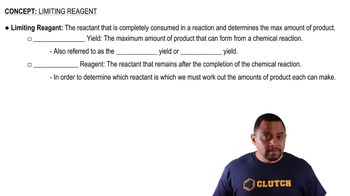
The limiting reactant is the substance that is completely consumed first in a chemical reaction, thus determining the maximum amount of product that can be formed. Identifying the limiting reactant is crucial for calculating the amounts of products and remaining reactants after the reaction. In the case of the combustion of acetylene and oxygen, one of these reactants will limit the formation of CO2 and H2O.
추천 영상:
가이드 코스
01:30
Limiting Reagent Concept

Combustion Reaction

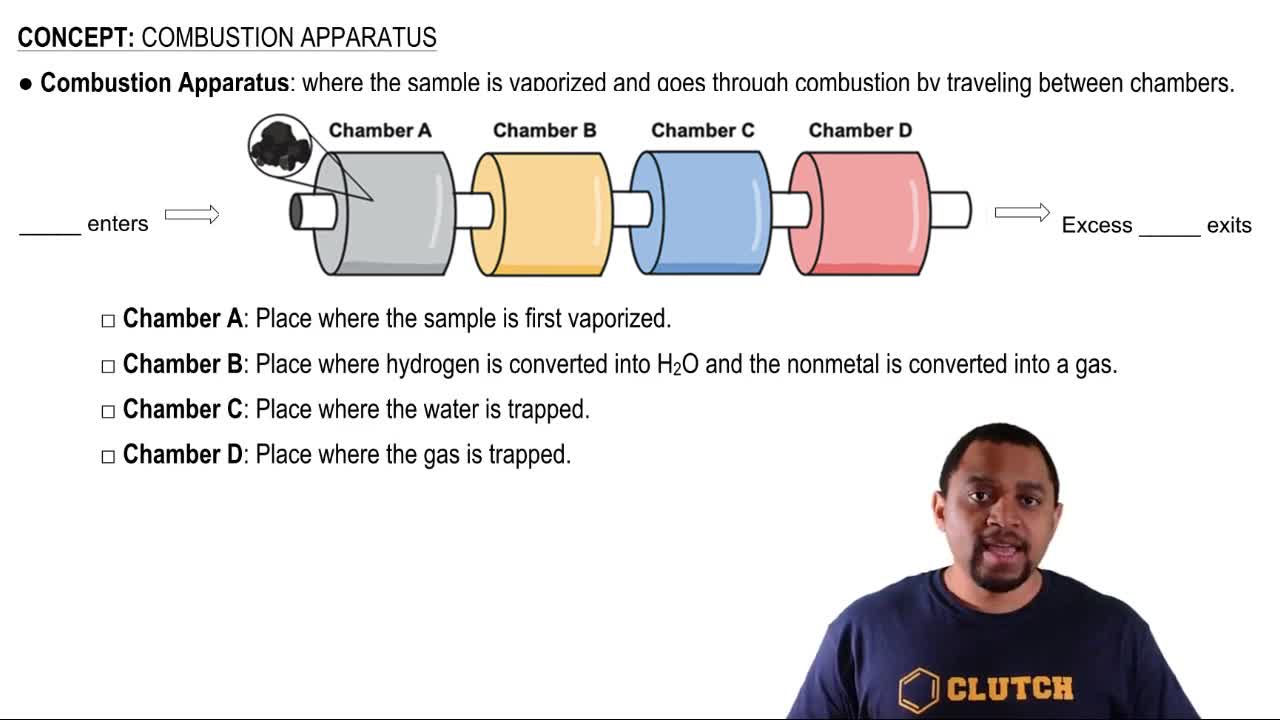
A combustion reaction is a chemical process in which a substance (usually a hydrocarbon) reacts with oxygen to produce carbon dioxide and water, releasing energy in the form of heat and light. The general form of a combustion reaction can be represented as: hydrocarbon + O2 → CO2 + H2O. Understanding the products and the stoichiometry involved in combustion reactions is vital for solving problems related to the amounts of reactants and products.
추천 영상:
가이드 코스
02:24
Combustion Apparatus
관련 실천
교과서 질문

(b) Because atoms are spherical, they cannot occupy all of the space of the cube. The silver atoms pack in the solid in such a way that 74% of the volume of the solid is actually filled with the silver atoms. Calculate the volume of a single silver atom.

교과서 질문

A mixture of N21g2 and H21g2 reacts in a closed container to form ammonia, NH31g2. The reaction ceases before either reactant has been totally consumed. At this stage 3.0 mol N2, 3.0 mol H2, and 3.0 mol NH3 are present. How many moles of N2 and H2 were present originally?

978
views
교과서 질문

When a mixture of 10.0 g of acetylene (C2H2) and 10.0 g of oxygen (O2) is ignited, the resulting combustion reaction produces CO2 and H2O. (c) How many grams of CO2 and H2O are present after the reaction is complete?

394
views
교과서 질문
Viridicatumtoxin B, C30H31NO10, is a natural antibiotic compound. It requires a synthesis of 12 steps in the laboratory. Assuming all steps have equivalent yields of 85%, which is the final percent yield of the total synthesis?
393
views
교과서 질문

A mixture containing KClO3, K2CO3, KHCO3, and KCl was heated, producing CO2, O2, and H2O gases according to the following equations: 2 KClO31s2¡2 KCl1s2 + 3 O21g2 2 KHCO31s2¡K2O1s2 + H2O1g2 + 2 CO21g2 K2CO31s2¡K2O1s2 + CO21g2 The KCl does not react under the conditions of the reaction. If 100.0 g of the mixture produces 1.80 g of H2O, 13.20 g of CO2, and 4.00 g of O2, what was the composition of the original mixture? (Assume complete decomposition of the mixture.) How many grams of K2CO3 were in the original mixture?

1325
views