Ch.3 - Chemical Reactions and Reaction Stoichiometry
Brown - Chemistry: The Central Science 14th Edition
Brown14th EditionChemistry: The Central ScienceISBN: 9780134414232당신이 사용하는 게 아니라요?교과서 변경
3장, 문제 16a,b

Write balanced chemical equations to correspond to each of the following descriptions: (a) When sulfur trioxide gas reacts with water, a solution of sulfuric acid forms. (b) Boron sulfide, B2S3(s), reacts violently with water to form dissolved boric acid, H3BO3, and hydrogen sulfide gas.

검증된 단계별 안내
1
Identify the reactants and products in the chemical reaction. The reactants are boron sulfide \( \text{B}_2\text{S}_3 \) and water \( \text{H}_2\text{O} \). The products are boric acid \( \text{H}_3\text{BO}_3 \) and hydrogen sulfide gas \( \text{H}_2\text{S} \).
Write the unbalanced chemical equation using the chemical formulas: \( \text{B}_2\text{S}_3 (s) + \text{H}_2\text{O} (l) \rightarrow \text{H}_3\text{BO}_3 (aq) + \text{H}_2\text{S} (g) \).
Balance the boron atoms. There are 2 boron atoms in \( \text{B}_2\text{S}_3 \), so you need 2 \( \text{H}_3\text{BO}_3 \) molecules on the product side: \( \text{B}_2\text{S}_3 (s) + \text{H}_2\text{O} (l) \rightarrow 2\text{H}_3\text{BO}_3 (aq) + \text{H}_2\text{S} (g) \).
Balance the sulfur atoms. There are 3 sulfur atoms in \( \text{B}_2\text{S}_3 \), so you need 3 \( \text{H}_2\text{S} \) molecules on the product side: \( \text{B}_2\text{S}_3 (s) + \text{H}_2\text{O} (l) \rightarrow 2\text{H}_3\text{BO}_3 (aq) + 3\text{H}_2\text{S} (g) \).
Balance the hydrogen and oxygen atoms. You have 6 hydrogen atoms from 2 \( \text{H}_3\text{BO}_3 \) and 6 from 3 \( \text{H}_2\text{S} \), totaling 12 hydrogen atoms, requiring 6 \( \text{H}_2\text{O} \) molecules. Also, 6 oxygen atoms are needed for 2 \( \text{H}_3\text{BO}_3 \), which are provided by 6 \( \text{H}_2\text{O} \): \( \text{B}_2\text{S}_3 (s) + 6\text{H}_2\text{O} (l) \rightarrow 2\text{H}_3\text{BO}_3 (aq) + 3\text{H}_2\text{S} (g) \).

비슷한 문제에 대한 검증된 영상 답변:

이 영상 해법은 위 문제에 도움이 된다고 튜터들이 추천한 것입니다.
영상 길이:
2m

주요 개념

질문에 올바르게 답하기 위해 반드시 이해해야 하는 핵심 개념들은 다음과 같습니다.

Chemical Equations

Chemical equations represent the reactants and products in a chemical reaction using their chemical formulas. They must be balanced to obey the law of conservation of mass, which states that matter cannot be created or destroyed in a chemical reaction. Each side of the equation must have the same number of atoms for each element involved.
추천 영상:
가이드 코스
01:32
Balancing Chemical Equations

Reactivity of Boron Compounds

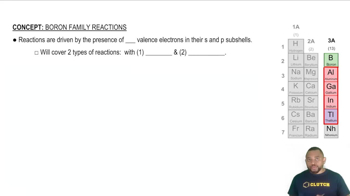
Boron compounds, such as boron sulfide (B2S3), can exhibit unique reactivity patterns, particularly with water. When boron sulfide reacts with water, it typically produces boric acid (H3BO3) and hydrogen sulfide (H2S). Understanding the behavior of boron compounds in reactions is crucial for predicting the products formed.
추천 영상:
가이드 코스
01:14
Boron Family Reactions

Acid-Base Reactions

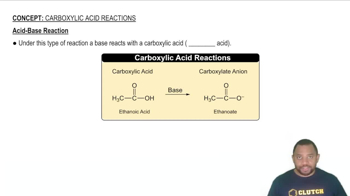
Acid-base reactions involve the transfer of protons (H+) between reactants. In this case, boric acid acts as a weak acid, while hydrogen sulfide can be considered a weak acid as well. Recognizing the nature of these substances helps in understanding the overall reaction and the resulting products, including their states and solubility in water.
추천 영상:
가이드 코스
01:09
Acid-Base Reaction