Determine the oxidation number for the indicated element in each of the following substances: (c) P in AgPF6
Ch.4 - Reactions in Aqueous Solution
4장, 문제 48f
Determine the oxidation number of sulfur in each of the following substances: (f) Which region(s) of the periodic table contains elements that can adopt both positive and negative oxidation numbers?
검증된 단계별 안내1
To determine the oxidation number of sulfur in a compound, first identify the compound's chemical formula and the known oxidation states of other elements in the compound.
Use the rule that the sum of the oxidation numbers in a neutral compound is zero, and in a polyatomic ion, it is equal to the ion's charge.
Assign oxidation numbers to the known elements based on common oxidation states: for example, oxygen is usually -2, and hydrogen is usually +1.
Solve for the unknown oxidation number of sulfur by setting up an equation based on the sum of the oxidation numbers equaling the total charge of the compound or ion.
For the second part of the question, consider that elements in the p-block of the periodic table, particularly those in groups 14-17, can often adopt both positive and negative oxidation numbers due to their ability to gain or lose electrons.

비슷한 문제에 대한 검증된 영상 답변:
이 영상 해법은 위 문제에 도움이 된다고 튜터들이 추천한 것입니다.
영상 길이:
2m주요 개념
질문에 올바르게 답하기 위해 반드시 이해해야 하는 핵심 개념들은 다음과 같습니다.
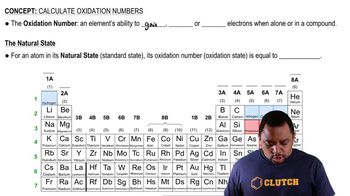
Oxidation Number
The oxidation number, or oxidation state, is a value assigned to an element in a compound that reflects its degree of oxidation or reduction. It indicates the number of electrons an atom can gain, lose, or share when forming chemical bonds. Oxidation numbers are crucial for understanding redox reactions and determining the electron flow in chemical processes.
추천 영상:
가이드 코스
Oxidation Numbers
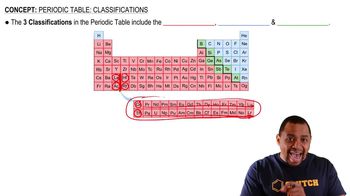
Periodic Table Regions
The periodic table is organized into regions that reflect the properties of elements. Elements in the leftmost groups (alkali and alkaline earth metals) typically have positive oxidation states, while elements in the rightmost groups (nonmetals) can exhibit both positive and negative oxidation states. Transition metals also frequently show variable oxidation states, making them versatile in chemical reactions.
추천 영상:
가이드 코스
Periodic Table Classifications
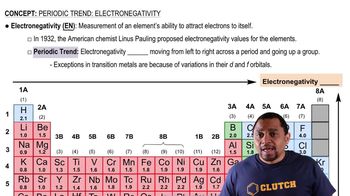
Electronegativity
Electronegativity is a measure of an atom's ability to attract and hold onto electrons in a chemical bond. Elements with high electronegativity, such as halogens, tend to gain electrons and adopt negative oxidation states, while those with low electronegativity, like alkali metals, tend to lose electrons and adopt positive oxidation states. Understanding electronegativity helps predict the oxidation states of elements in compounds.
추천 영상:
가이드 코스
Electronegativity Trends
관련 실천
교과서 질문
758
views
교과서 질문
Determine the oxidation number for the indicated element in each of the following substances: (a) S in SO3 (b) Ti in TiCl4
354
views
교과서 질문
Determine the oxidation number for the indicated element in each of the following substances: (d) N in HNO3
399
views
교과서 질문
Determine the oxidation number of sulfur in each of the following substances: (a) barium sulfate, BaSO4 (b) sulfurous acid, H2SO3 (c) strontium sulfide, SrS
470
views
교과서 질문
Determine the oxidation number of sulfur in each of the following substances: (d) hydrogen sulfide, H2S
524
views
교과서 질문
Determine the oxidation number of sulfur in each of the following substances: (e) Locate sulfur in the periodic table in Exercise 4.47; what region is it in?
499
views