Ch.4 - Reactions in Aqueous Solution
Brown - Chemistry: The Central Science 14th Edition
Brown14th EditionChemistry: The Central ScienceISBN: 9780134414232당신이 사용하는 게 아니라요?교과서 변경
4장, 문제 115b

Federal regulations set an upper limit of 50 parts per million (ppm) of NH3 in the air in a work environment [that is, 50 molecules of NH3(g) for every million molecules in the air]. Air from a manufacturing operation was drawn through a solution containing 1.00⨉102 mL of 0.0105 M HCl. The NH3 reacts with HCl according to: NH3(aq) + HCl(aq) → NH4Cl(aq). After drawing air through the acid solution for 10.0 min at a rate of 10.0 L/min, the acid was titrated. The remaining acid needed 13.1 mL of 0.0588 M NaOH to reach the equivalence point. (b) How many ppm of NH3 were in the air? (Air has a density of 1.20 g/L and an average molar mass of 29.0 g/mol under the conditions of the experiment.)

검증된 단계별 안내
1
Calculate the total volume of air drawn through the solution: \(10.0 \text{ L/min} \times 10.0 \text{ min} = 100.0 \text{ L}\).
Determine the initial moles of HCl in the solution: \(0.0105 \text{ M} \times 0.100 \text{ L} = 0.00105 \text{ mol HCl}\).
Calculate the moles of NaOH used in the titration: \(0.0588 \text{ M} \times 0.0131 \text{ L} = 0.00076908 \text{ mol NaOH}\).
Determine the moles of HCl that reacted with NH\(_3\): Subtract the moles of NaOH from the initial moles of HCl: \(0.00105 \text{ mol} - 0.00076908 \text{ mol} = 0.00028092 \text{ mol HCl}\).
Convert the moles of NH\(_3\) to ppm: Calculate the moles of air using its density and molar mass, then use the ratio of NH\(_3\) moles to air moles to find ppm.

비슷한 문제에 대한 검증된 영상 답변:

이 영상 해법은 위 문제에 도움이 된다고 튜터들이 추천한 것입니다.
영상 길이:
5m

주요 개념

질문에 올바르게 답하기 위해 반드시 이해해야 하는 핵심 개념들은 다음과 같습니다.

Stoichiometry

Stoichiometry is the calculation of reactants and products in chemical reactions based on the balanced chemical equation. It allows us to determine the amount of substances consumed and produced in a reaction. In this case, understanding the stoichiometric relationship between NH<sub>3</sub> and HCl is crucial for calculating the concentration of NH<sub>3</sub> in the air after the reaction.
추천 영상:
가이드 코스
01:16
Stoichiometry Concept

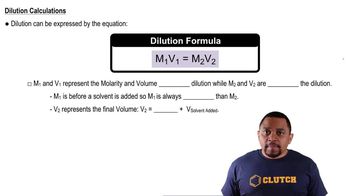
Molarity and Dilution

Molarity (M) is a measure of concentration defined as the number of moles of solute per liter of solution. In this problem, the initial concentration of HCl and the volume used are essential for determining how much HCl reacted with NH<sub>3</sub>. Additionally, the concept of dilution is important when calculating the remaining concentration of HCl after the reaction, which is then used to find the amount of NH<sub>3</sub> present.
추천 영상:
가이드 코스
00:58
Dilution Equation

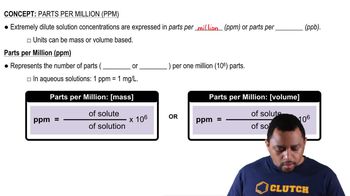
Parts Per Million (ppm)

Parts per million (ppm) is a unit of measurement used to describe the concentration of a substance in a solution or mixture. It indicates how many parts of a substance are present in one million parts of the total solution. In this question, converting the amount of NH<sub>3</sub> found in the air sample to ppm is necessary to assess compliance with federal regulations regarding air quality.
추천 영상:
가이드 코스
01:38
Parts per Million (ppm)