Ch.4 - Reactions in Aqueous Solution
Brown - Chemistry: The Central Science 14th Edition
Brown14th EditionChemistry: The Central ScienceISBN: 9780134414232당신이 사용하는 게 아니라요?교과서 변경
4장, 문제 105a

Suppose you have 3.00 g of powdered zinc metal, 3.00g of powdered silver metal and 500.0 mL of a 0.2 M copper(II) nitrate solution. (a) Which metal will react with the copper(II) nitrate solution?

검증된 단계별 안내
1
Identify the metals involved in the reaction: zinc (Zn) and silver (Ag).
Write the balanced chemical equations for the possible reactions of each metal with copper(II) nitrate (Cu(NO_3)_2).
For zinc: Zn + Cu(NO_3)_2 \(\rightarrow\) Zn(NO_3)_2 + Cu. Zinc can displace copper from the solution because it is more reactive.
For silver: Ag + Cu(NO_3)_2 \(\rightarrow\) No reaction. Silver is less reactive than copper and cannot displace it from the solution.
Conclude that zinc will react with the copper(II) nitrate solution, while silver will not.

비슷한 문제에 대한 검증된 영상 답변:

이 영상 해법은 위 문제에 도움이 된다고 튜터들이 추천한 것입니다.
영상 길이:
1m

주요 개념

질문에 올바르게 답하기 위해 반드시 이해해야 하는 핵심 개념들은 다음과 같습니다.

Reactivity of Metals

The reactivity of metals is determined by their ability to lose electrons and form positive ions. In a displacement reaction, a more reactive metal can displace a less reactive metal from its compound. Understanding the reactivity series of metals helps predict which metal will react with a given solution.
추천 영상:
가이드 코스
03:12
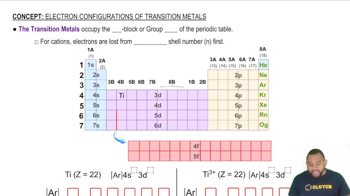
Transition Metals

Displacement Reactions

Displacement reactions occur when a more reactive element displaces a less reactive element from a compound. In this scenario, zinc and silver are compared to copper(II) ions in the solution. The metal that is higher in the reactivity series will replace the copper ions, leading to the formation of a new compound.
추천 영상:
가이드 코스
01:11
Single Displacement Reactions

Molarity and Stoichiometry

Molarity is a measure of concentration, defined as moles of solute per liter of solution. In this question, the concentration of copper(II) nitrate is given, which is essential for calculating the number of moles available for reaction. Stoichiometry allows us to relate the amounts of reactants and products in a chemical reaction, helping to determine the limiting reactant.
추천 영상:
가이드 코스
03:10
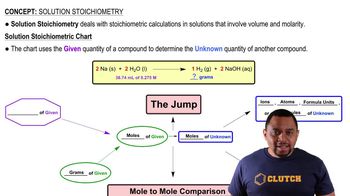
Solution Stoichiometry
관련 실천
교과서 질문

(a) By titration, 15.0 mL of 0.1008 M sodium hydroxide is needed to neutralize a 0.2053-g sample of a weak acid. What is the molar mass of the acid if it is monoprotic?

1329
views

교과서 질문

Suppose you have 3.00 g of powdered zinc metal, 3.00g of powdered silver metal and 500.0 mL of a 0.2 M copper(II) nitrate solution. (b) What is the net ionic equation that describes this reaction?

1
views
교과서 질문

Citric acid, C6H8O7, is a triprotic acid. It occurs naturally in citrus fruits like lemons and has applications in food flavouring and preservatives. A solution containing an unknown concentration of the acid is titrated with KOH. It requires 23.20 mL of 0.500 M KOH solution to titrate all three acidic protons in 100.00 mL of the citric acid solution. Write a balanced net ionic equation for the neutralization reaction.

759
views
교과서 질문

Citric acid, C6H8O7, is a triprotic acid. It occurs naturally in citrus fruits like lemons and has applications in food flavouring and preservatives. A solution containing an unknown concentration of the acid is titrated with KOH. It requires 23.20 mL of 0.500 M KOH solution to titrate all three acidic protons in 100.00 mL of the citric acid solution. Calculate the molarity of the citric acid solution.

2019
views
교과서 질문
(c) If 18.65 mL of the caesium hydroxide solution was needed to neutralize a 42.3 mL aliquot of the hydroiodic acid solution, what is the concentration (molarity) of the acid?
492
views
교과서 질문

Suppose you have 3.00 g of powdered zinc metal, 3.00g of powdered silver metal and 500.0 mL of a 0.2 M copper(II) nitrate solution. (d) What is the molarity of Cu2+ ions in the resulting solution?

352
views