(a) Calculate the molarity of a solution that contains 0.175 mol ZnCl2 in exactly 150 mL of solution.

Ch.4 - Reactions in Aqueous Solution
4장, 문제 60b
You make 1.000 L of an aqueous solution that contains 35.0 g of sucrose (C12H22O11). (b) How many liters of water would you have to add to this solution to reduce the molarity you calculated in part (a) by a factor of two?
검증된 단계별 안내1
Calculate the molarity of the initial solution using the formula: \( M = \frac{n}{V} \), where \( n \) is the number of moles of solute and \( V \) is the volume of the solution in liters.
Determine the number of moles of sucrose by using its molar mass: \( n = \frac{\text{mass of sucrose}}{\text{molar mass of sucrose}} \).
Use the molarity from part (a) and divide it by 2 to find the new desired molarity.
Set up the equation for the new molarity: \( M_{\text{new}} = \frac{n}{V_{\text{new}}} \), where \( V_{\text{new}} \) is the new total volume of the solution.
Solve for \( V_{\text{new}} \) and subtract the original volume (1.000 L) to find the volume of water to add.

비슷한 문제에 대한 검증된 영상 답변:
이 영상 해법은 위 문제에 도움이 된다고 튜터들이 추천한 것입니다.
영상 길이:
3m주요 개념
질문에 올바르게 답하기 위해 반드시 이해해야 하는 핵심 개념들은 다음과 같습니다.
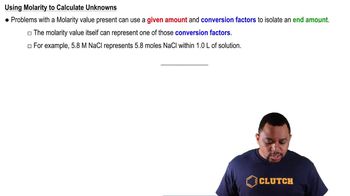
Molarity
Molarity is a measure of concentration defined as the number of moles of solute per liter of solution. It is expressed in moles per liter (mol/L) and is crucial for understanding how solute concentration affects chemical reactions and properties of solutions. In this context, calculating the initial molarity of sucrose in the solution is essential to determine how much water needs to be added to achieve the desired dilution.
추천 영상:
가이드 코스
Molarity
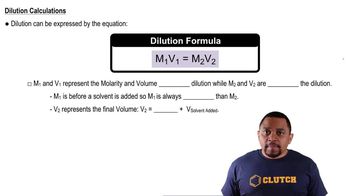
Dilution
Dilution is the process of reducing the concentration of a solute in a solution, typically by adding more solvent. The relationship between the initial and final concentrations and volumes can be described by the dilution equation, C1V1 = C2V2, where C is concentration and V is volume. Understanding this concept is key to solving the problem, as it allows for the calculation of the final volume needed to achieve half the original molarity.
추천 영상:
가이드 코스
Dilution Equation
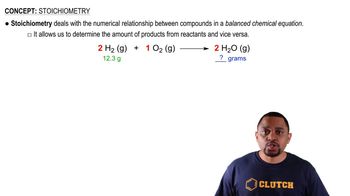
Stoichiometry
Stoichiometry involves the calculation of reactants and products in chemical reactions based on the conservation of mass. In the context of solutions, it helps in determining the relationships between the amounts of solute and solvent. For this question, stoichiometric principles are applied to find the volume of water needed to dilute the sucrose solution to the desired molarity, ensuring that the calculations adhere to the principles of conservation.
추천 영상:
가이드 코스
Stoichiometry Concept
관련 실천
교과서 질문
교과서 질문
a) Calculate the molarity of a solution made by dissolving 12.5 grams of Na2CrO4 in enough water to form exactly 750 mL of solution.
교과서 질문
(a) Is the number of moles of ions present in a solution an intensive or an extensive property?
448
views
교과서 질문
(c) How many milliliters of a 6.00 M NaOH solution are needed to provide 0.350 mol of NaOH?
1204
views
교과서 질문
The following reactions (note that the arrows are pointing only one direction) can be used to prepare an activity series for the halogens:
Br2(aq) + 2 NaI(aq) → 2 NaBr(aq) + I2(aq)
Cl2(aq) + 2 NaBr(aq) → 2 NaCl(aq) + Br2(aq)
(b) Predict whether a reaction will occur when elemental chlorine and potassium iodide are mixed.
1
views
교과서 질문
(b) Can you identify which one between 0.10 mol ZnCl2 and 0.1M ZnCl2 contains more Zn2+ ion? Why?
408
views