

Ch.5 - Thermochemistry
Brown - Chemistry: The Central Science 14th Edition
Brown14th EditionChemistry: The Central ScienceISBN: 9780134414232당신이 사용하는 게 아니라요?교과서 변경
5장, 문제 95a,b

The standard enthalpies of formation of gaseous propyne (C3H4), propylene (C3H6), and propane (C3H8) are +185.4, +20.4, and -103.8 kJ/mol, respectively. (a) Calculate the heat evolved per mole on combustion of each substance to yield CO2(g) and H2O(g). (b) Calculate the heat evolved on combustion of 1 kg of each substance.

검증된 단계별 안내
1
Convert the mass of each substance (1 kg) to moles using their respective molar masses.
Write the balanced chemical equation for the combustion of each substance: propyne, propylene, and propane.
Use the standard enthalpies of formation to calculate the enthalpy change (\( \Delta H_{\text{comb}} \)) for the combustion reaction of each substance.
Multiply the \( \Delta H_{\text{comb}} \) by the number of moles calculated in step 1 to find the total heat evolved for each substance.
Ensure the units are consistent and convert the total heat evolved to kilojoules if necessary.

비슷한 문제에 대한 검증된 영상 답변:

이 영상 해법은 위 문제에 도움이 된다고 튜터들이 추천한 것입니다.
영상 길이:
16m

주요 개념

질문에 올바르게 답하기 위해 반드시 이해해야 하는 핵심 개념들은 다음과 같습니다.

Standard Enthalpy of Formation

The standard enthalpy of formation is the change in enthalpy when one mole of a compound is formed from its elements in their standard states. It is a crucial concept in thermodynamics, as it allows for the calculation of the energy changes associated with chemical reactions, particularly combustion. The values provided for propyne, propylene, and propane indicate how much energy is absorbed or released during their formation.
추천 영상:
가이드 코스
02:34
Enthalpy of Formation

Combustion Reaction

A combustion reaction is a chemical process in which a substance reacts rapidly with oxygen, releasing energy in the form of heat and light. For hydrocarbons like propyne, propylene, and propane, the combustion reaction typically produces carbon dioxide and water. Understanding the stoichiometry of these reactions is essential for calculating the heat evolved during combustion, as it relates to the enthalpy changes of the reactants and products.
추천 영상:
가이드 코스
02:24
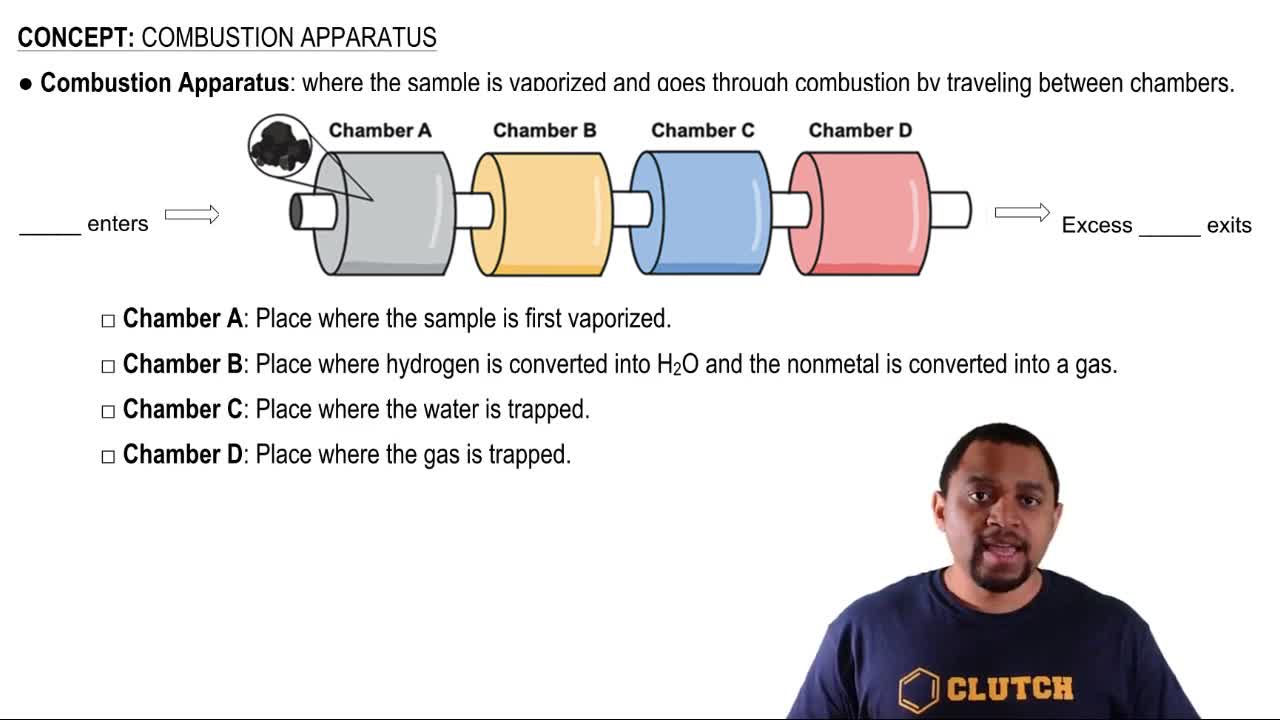
Combustion Apparatus

Heat of Combustion

The heat of combustion is the amount of energy released when a substance undergoes complete combustion with oxygen. It is often expressed in kJ/mol and can be derived from the standard enthalpies of formation of the reactants and products. To calculate the heat evolved on combustion of 1 kg of each hydrocarbon, one must convert the mass to moles and apply the heat of combustion values, which can be determined from the enthalpy of formation data.
추천 영상:
가이드 코스
02:24
Combustion Apparatus
관련 실천
교과서 질문

The heat of combustion of ethanol, C2H5OH(l), is -1367 kJ/mol. A bottle of stout (dark beer) contains up to 6.0% ethanol by mass. Assuming the density of the beer to be 1.0 g/mL, what is the caloric content due to the alcohol (ethanol) in a bottle of beer (500 mL)?

4703
views
교과서 질문

The standard enthalpies of formation of gaseous propyne (C3H4), propylene (C3H6), and propane (C3H8) are +185.4, +20.4, and -103.8 kJ/mol, respectively. (c) Which is the most efficient fuel in terms of heat evolved per unit mass?

1938
views
교과서 질문

It is interesting to compare the 'fuel value' of a hydrocarbon in a hypothetical world where oxygen is not the combustion agent. The enthalpy of formation of CF4(g) is -679.9 kJ/mol. Which of the following two reactions is the more exothermic?

CH4(g) + 2 O2(g) → CO2(g) + 2 H2O(g)

CH4(g) + 4 F2(g) → CF4(g) + 4 HF(g)

854
views
교과서 질문

The heat of combustion of fructose, C6H12O6, is -2812 kJ/mol. If a fresh golden delicious apple weighing 120 g contains 16.0 g of fructose, what caloric content does the fructose contribute to the apple?

1493
views
교과서 질문

At the end of 2012, global population was about 7.0 billion people. What mass of glucose in kg would be needed to provide 1500 Cal/person/day of nourishment to the global population for one year? Assume that glucose is metabolized entirely to CO2(𝑔) and H2O(𝑙) according to the following thermochemical equation: C6H12O6(s) + 6 O2(𝑔) → 6 CO2(𝑔) + 6 H2O(𝑙) ΔH° = -2803 kJ

839
views