
Ch.5 - Thermochemistry
Brown - Chemistry: The Central Science 14th Edition
Brown14th EditionChemistry: The Central ScienceISBN: 9780134414232당신이 사용하는 게 아니라요?교과서 변경
5장, 문제 59a

Under constant-volume conditions, the heat of combustion of benzoic acid (C6H5O6) is 15.57 kJ/g. A 3.500-g sample of sucrose is burned in a bomb calorimeter. The temperature of the calorimeter increases from 20.94 to 24.72 °C. (a) What is the total heat capacity of the calorimeter?

검증된 단계별 안내
1
Identify the known values: the heat of combustion of benzoic acid is 15.57 kJ/g, the mass of the sucrose sample is 3.500 g, and the temperature change (\(\Delta T\)) is from 20.94 °C to 24.72 °C.
Calculate the total heat released by the combustion of the sucrose sample using the formula \( q = m \times \Delta H \), where \( m \) is the mass of the sucrose and \( \Delta H \) is the heat of combustion per gram.
Determine the temperature change \( \Delta T \) of the calorimeter by subtracting the initial temperature from the final temperature.
Use the formula for heat capacity \( C = \frac{q}{\Delta T} \) to find the total heat capacity of the calorimeter, where \( q \) is the heat released and \( \Delta T \) is the temperature change.
Substitute the values obtained from the previous steps into the formula to calculate the total heat capacity of the calorimeter.

비슷한 문제에 대한 검증된 영상 답변:

이 영상 해법은 위 문제에 도움이 된다고 튜터들이 추천한 것입니다.
영상 길이:
2m

주요 개념

질문에 올바르게 답하기 위해 반드시 이해해야 하는 핵심 개념들은 다음과 같습니다.

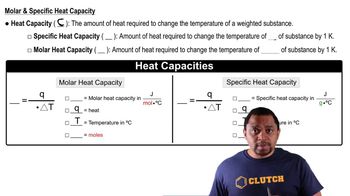
Heat Capacity

Heat capacity is the amount of heat energy required to raise the temperature of a substance by one degree Celsius. In calorimetry, it is crucial for determining how much heat is absorbed or released by the calorimeter during a reaction. The total heat capacity of a calorimeter can be calculated using the formula C = q/ΔT, where q is the heat exchanged and ΔT is the change in temperature.
추천 영상:

Calorimetry

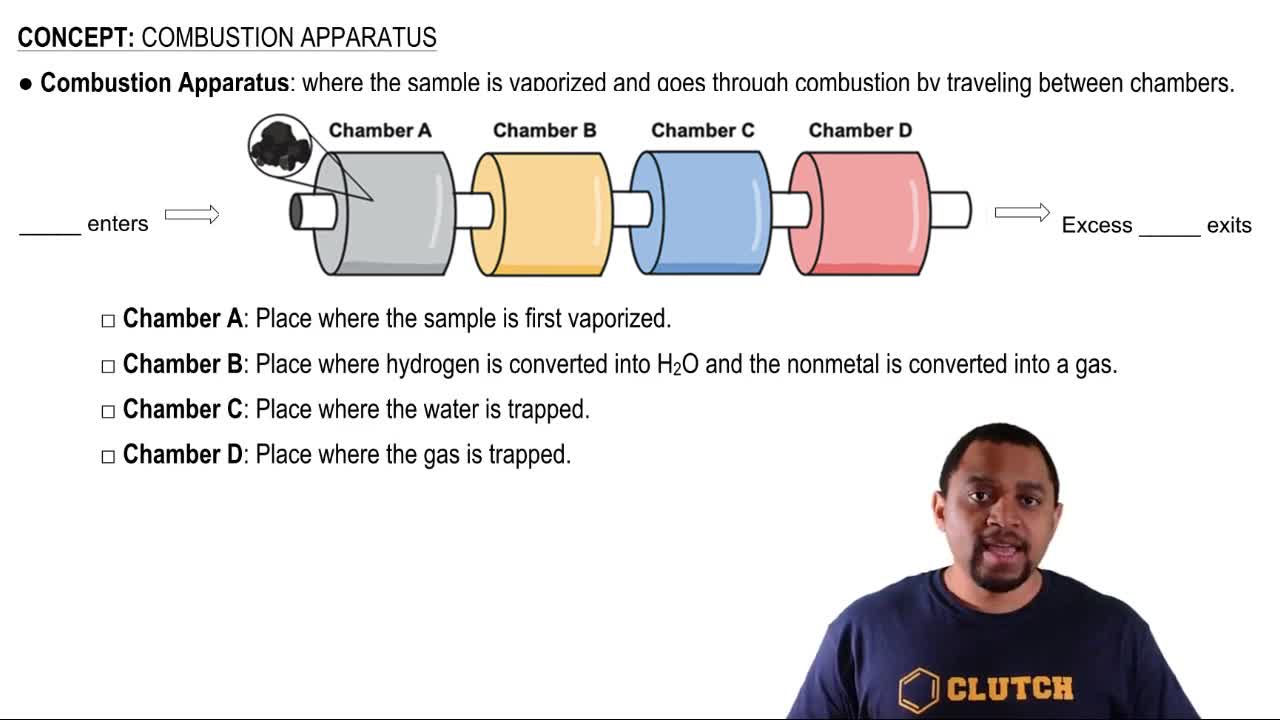
Calorimetry is the science of measuring the heat of chemical reactions or physical changes. In a bomb calorimeter, the heat released from a combustion reaction is absorbed by the calorimeter and the surrounding water, leading to a measurable temperature change. This technique allows for the determination of the energy content of fuels and other substances.
추천 영상:
가이드 코스
00:50
Constant-Volume Calorimetry

Combustion Reaction

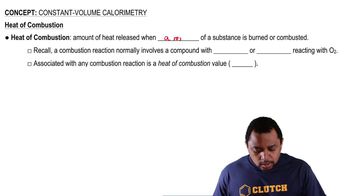
A combustion reaction is a chemical process in which a substance reacts rapidly with oxygen, producing heat and light. In the context of calorimetry, the heat released during the combustion of a sample, such as sucrose, is measured to determine its energy content. The heat of combustion is typically expressed in kJ/g, indicating the energy released per gram of the substance burned.
추천 영상:
가이드 코스
02:24
Combustion Apparatus
관련 실천
교과서 질문

A 1.50-g sample of quinone (C6H4O2) is burned in a bomb calorimeter whose total heat capacity is 8.500 kJ/°C. The temperature of the calorimeter increases from 25.00 to 29.49 °C. (a) Write a balanced chemical equation for the bomb calorimeter reaction.

350
views
교과서 질문

A 2.20-g sample of phenol (C6H5OH) was burned in a bomb calorimeter whose total heat capacity is 11.90 kJ/°C. The temperature of the calorimeter plus contents increased from 21.50 to 27.50 °C. (b) What is the heat of combustion per mole of phenol?

780
views
교과서 질문

Under constant-volume conditions, the heat of combustion of benzoic acid (C6H5O6) is 15.57 kJ/g. A 3.500-g sample of sucrose is burned in a bomb calorimeter. The temperature of the calorimeter increases from 20.94 to 24.72 °C. (b) If the size of the sucrose sample had been exactly twice as large, what would the temperature change of the calorimeter have been?

1040
views
교과서 질문

Under constant-volume conditions, the heat of combustion of naphthalene (C10H8) is 40.18 kJ/g. A 2.50-g sample of naphthalene is burned in a bomb calorimeter. The temperature of the calorimeter increases from 21.50 to 28.83 °C. (c) Suppose that in changing samples, a portion of the water in the calorimeter were lost. In what way, if any, would this change the heat capacity of the calorimeter?

1165
views
교과서 질문

A 2.20-g sample of phenol (C6H5OH) was burned in a bomb calorimeter whose total heat capacity is 11.90 kJ/°C. The temperature of the calorimeter plus contents increased from 21.50 to 27.50 °C. (a) Write a balanced chemical equation for the bomb calorimeter reaction.

704
views