Ch.6 - Electronic Structure of Atoms
Brown - Chemistry: The Central Science 14th Edition
Brown14th EditionChemistry: The Central ScienceISBN: 9780134414232당신이 사용하는 게 아니라요?교과서 변경
6장, 문제 71

What is the maximum number of electrons that can occupy each of the following subshells? (a) 3s, (b) 2p, (c) 4d, (d) 5s.

검증된 단계별 안내
1
First, let's understand the concept of subshells. In an atom, electrons are arranged in energy levels, also known as shells. Each shell is divided into subshells, which are designated as s, p, d, and f. The number before the letter represents the energy level or shell number, and the letter represents the type of subshell.
The maximum number of electrons that can occupy a subshell is determined by the type of subshell. The s subshell can hold a maximum of 2 electrons, the p subshell can hold a maximum of 6 electrons, the d subshell can hold a maximum of 10 electrons, and the f subshell can hold a maximum of 14 electrons.
For subshell (a) 3s, since it's an s subshell, it can hold a maximum of 2 electrons.
For subshell (b) 2p, since it's a p subshell, it can hold a maximum of 6 electrons.
For subshell (c) 4d, since it's a d subshell, it can hold a maximum of 10 electrons.
For subshell (d) 5s, since it's an s subshell, it can hold a maximum of 2 electrons.

비슷한 문제에 대한 검증된 영상 답변:

이 영상 해법은 위 문제에 도움이 된다고 튜터들이 추천한 것입니다.
영상 길이:
6m

주요 개념

질문에 올바르게 답하기 위해 반드시 이해해야 하는 핵심 개념들은 다음과 같습니다.

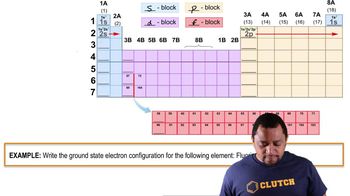
Electron Configuration

Electron configuration describes the distribution of electrons in an atom's orbitals. Each electron occupies a specific subshell based on energy levels and follows the Pauli exclusion principle, which states that no two electrons can have the same set of quantum numbers. Understanding electron configuration is essential for determining how many electrons can fit into each subshell.
추천 영상:
가이드 코스
01:33
Electron Configuration Example

Subshells and Their Capacities

Subshells are divisions of electron shells and are designated as s, p, d, and f. Each subshell has a specific maximum number of electrons it can hold: s subshells can hold 2 electrons, p subshells can hold 6, d subshells can hold 10, and f subshells can hold 14. This capacity is derived from the formula 2n², where n is the principal quantum number.
추천 영상:

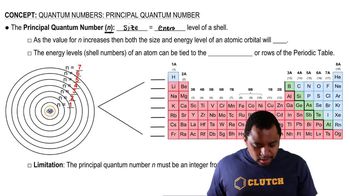
Quantum Numbers

Quantum numbers are sets of numerical values that describe the unique quantum state of an electron in an atom. The principal quantum number (n) indicates the energy level, while the azimuthal quantum number (l) defines the subshell type (s, p, d, f). Understanding quantum numbers is crucial for determining the arrangement of electrons and their respective subshells.
추천 영상:
가이드 코스
02:55
Principal Quantum Number