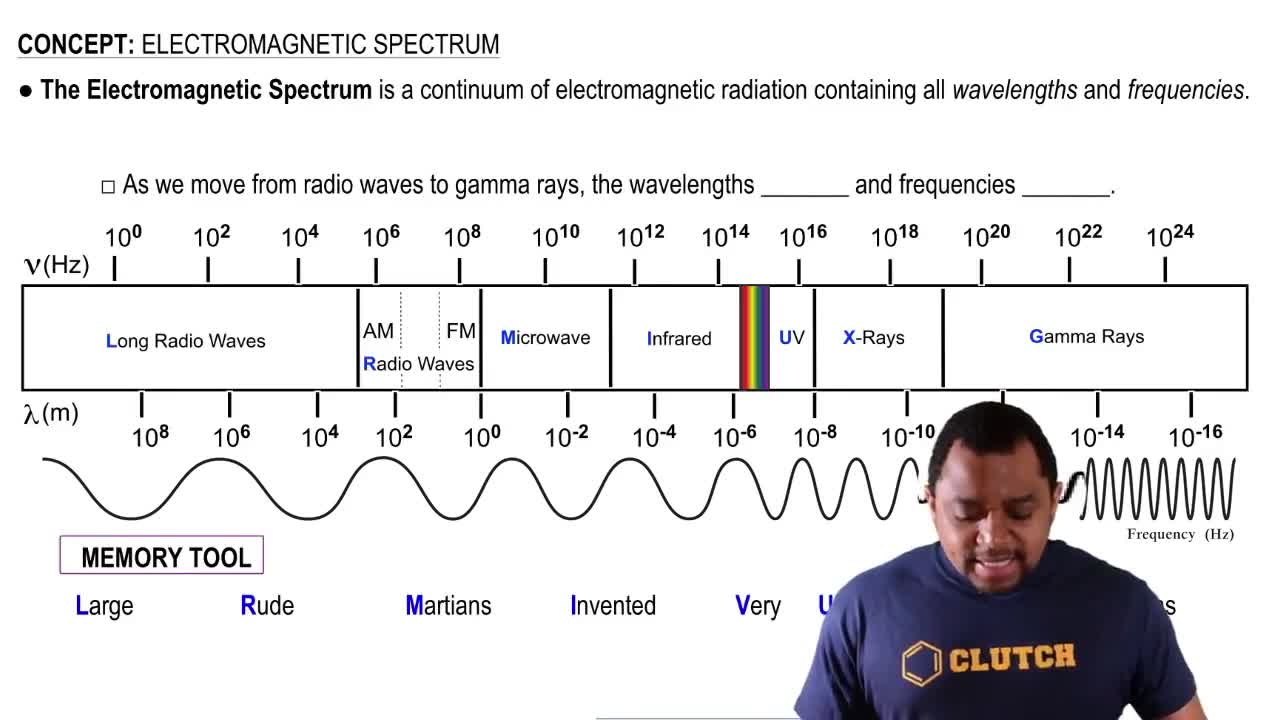
Arrange the following kinds of electromagnetic radiation in order of increasing wavelength: infrared, green light, red light, radio waves, X rays, ultraviolet light.
Ch.6 - Electronic Structure of Atoms
6장, 문제 19a
(a) What is the frequency of radiation that has a wavelength of 10 µm, about the size of a bacterium?
검증된 단계별 안내1
Step 1: Understand that the frequency (ν) of a wave is inversely proportional to its wavelength (λ). This relationship is expressed by the equation c = λν, where c is the speed of light (3.00 x 10^8 m/s).
Step 2: Convert the wavelength from micrometers (µm) to meters (m) since the speed of light is given in meters per second. There are 1 x 10^-6 meters in a micrometer, so multiply the given wavelength by this conversion factor.
Step 3: Rearrange the equation c = λν to solve for frequency: ν = c / λ.
Step 4: Substitute the values for the speed of light (c) and the wavelength (λ) into the equation to calculate the frequency.
Step 5: Ensure your answer is in the correct units. The frequency should be in Hertz (Hz), which is equivalent to 1/s or s^-1.

비슷한 문제에 대한 검증된 영상 답변:
이 영상 해법은 위 문제에 도움이 된다고 튜터들이 추천한 것입니다.
영상 길이:
2m주요 개념
질문에 올바르게 답하기 위해 반드시 이해해야 하는 핵심 개념들은 다음과 같습니다.
Electromagnetic Spectrum
The electromagnetic spectrum encompasses all types of electromagnetic radiation, which vary in wavelength and frequency. It includes radio waves, microwaves, infrared, visible light, ultraviolet, X-rays, and gamma rays. Understanding where a specific wavelength, like 10 µm, falls within this spectrum helps in identifying its properties and applications.
추천 영상:
가이드 코스
Electromagnetic Spectrum
Wavelength and Frequency Relationship
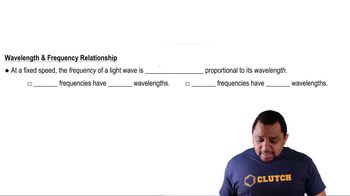
Wavelength and frequency are inversely related properties of electromagnetic waves, described by the equation c = λν, where c is the speed of light, λ is the wavelength, and ν is the frequency. This means that as the wavelength increases, the frequency decreases, and vice versa. This relationship is crucial for calculating the frequency of radiation given its wavelength.
추천 영상:
가이드 코스
Frequency-Wavelength Relationship
Units of Measurement
In chemistry and physics, it is essential to use consistent units when performing calculations. Wavelength is often measured in meters (m) or micrometers (µm), while frequency is measured in hertz (Hz). Converting units appropriately is necessary to ensure accurate calculations, especially when dealing with wavelengths in micrometers.
추천 영상:
가이드 코스
Units of Radiation Measurement
관련 실천
교과서 질문
2457
views
교과서 질문
(d) What distance does electromagnetic radiation travel in 0.38 ps?
901
views
교과서 질문
(b) What is the wavelength of radiation that has a frequency of 5.50 × 10¹⁴ s-1?
교과서 질문
Determine which of the following statements are false and correct them. Determine which of the following statements are false and correct them. (a) The frequency of radiation increases as the wavelength increases. (b) Electromagnetic radiation travels through a vacuum at a constant speed, regardless of wavelength. (c) Infrared light has higher frequencies than visible light. (d) The glow from a fireplace, the energy within a microwave oven, and a foghorn blast are all forms of electromagnetic radiation.
1450
views
교과서 질문
(c) Would the radiations in part (a) or part (b) be detected by an X-ray detector?