Ch.6 - Electronic Structure of Atoms
Brown - Chemistry: The Central Science 14th Edition
Brown14th EditionChemistry: The Central ScienceISBN: 9780134414232당신이 사용하는 게 아니라요?교과서 변경
6장, 문제 9c

The contour representation of one of the orbitals for the n = 3 shell of a hydrogen atom is shown here. (c) In which of the following ways would you modify this sketch if the value of the magnetic quantum number, ml, were to change? (i) It would be drawn larger, (ii) the number of lobes would change, (iii) the lobes of the orbital would point in a different direction, (iv) there would be no change in the sketch.

검증된 단계별 안내
1
Understand the quantum numbers: The magnetic quantum number, m_l, determines the orientation of the orbital in space. It can take values from -l to +l, where l is the azimuthal quantum number.
Identify the effect of m_l: Changing m_l affects the orientation of the orbital but not its size or shape. Therefore, the number of lobes and their size remain unchanged.
Consider the options: (i) It would be drawn larger - this is incorrect as m_l does not affect the size. (ii) The number of lobes would change - this is incorrect as m_l does not affect the number of lobes.
Evaluate the correct option: (iii) The lobes of the orbital would point in a different direction - this is correct as m_l changes the orientation. (iv) There would be no change in the sketch - this is incorrect as m_l affects orientation.
Conclude: The correct modification when m_l changes is that the lobes of the orbital would point in a different direction, corresponding to option (iii).

비슷한 문제에 대한 검증된 영상 답변:

이 영상 해법은 위 문제에 도움이 된다고 튜터들이 추천한 것입니다.
영상 길이:
8m

주요 개념

질문에 올바르게 답하기 위해 반드시 이해해야 하는 핵심 개념들은 다음과 같습니다.

Quantum Numbers

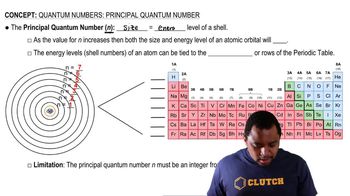
Quantum numbers are a set of numerical values that describe the unique quantum state of an electron in an atom. The principal quantum number (n) indicates the energy level, while the magnetic quantum number (ml) specifies the orientation of the orbital in space. Understanding these numbers is crucial for predicting the shape and orientation of atomic orbitals.
추천 영상:
가이드 코스
02:55
Principal Quantum Number

Orbital Shapes and Orientation

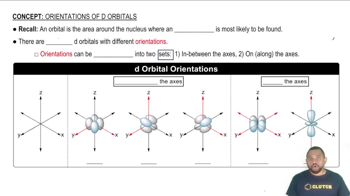
Atomic orbitals have distinct shapes and orientations based on their quantum numbers. The shape of an orbital is determined by the angular momentum quantum number (l), while the orientation is influenced by the magnetic quantum number (ml). Changes in ml can lead to different orientations of the lobes of the orbital, affecting how they are represented in sketches.
추천 영상:
가이드 코스
02:06
d Orbital Orientations

Hydrogen Atom Orbitals

In a hydrogen atom, the orbitals are defined by solutions to the Schrödinger equation, which describe the probability distribution of an electron. For the n = 3 shell, there are multiple orbitals (3s, 3p, 3d) with varying shapes and orientations. Understanding these orbitals helps in visualizing how changes in quantum numbers affect their representation.
추천 영상:
가이드 코스
01:51
Atomic Orbitals Example
관련 실천
교과서 질문

The accompanying drawing shows a contour plot for a dyz orbital. Consider the quantum numbers that could potentially correspond to this orbital. (b) What is the value of the angular momentum quantum number, l?

487
views

교과서 질문

Consider the three electronic transitions in a hydrogen atom shown here, labeled A, B, and C. (c) Calculate the wavelength of the photon emitted for each transition. Do any of these transitions lead to the emission of visible light? If so which one(s)?

Calculate the wavelength of the photon emitted for transition B.

969
views
교과서 질문

Consider a fictitious one-dimensional system with one electron. The wave function for the electron, drawn below, is c1x2 = sin x from x = 0 to x = 2p. (b) At what value or values of x will there be the greatest probability of finding the electron?

526
views
교과서 질문

The contour representation of one of the orbitals for the n = 3 shell of a hydrogen atom is shown here. (a) What is the quantum number l for this orbital?

448
views
교과서 질문

The accompanying drawing shows a contour plot for a dyz orbital. Consider the quantum numbers that could potentially correspond to this orbital. (c) What is the largest possible value of the magnetic quantum number, ml?

516
views
교과서 질문

The accompanying drawing shows a contour plot for a dyz orbital. Consider the quantum numbers that could potentially correspond to this orbital. (d) The probability density goes to zero along which of the following planes: xy, xz, or yz?

737
views