Ch.6 - Electronic Structure of Atoms
Brown - Chemistry: The Central Science 14th Edition
Brown14th EditionChemistry: The Central ScienceISBN: 9780134414232당신이 사용하는 게 아니라요?교과서 변경
6장, 문제 110d

The two most common isotopes of uranium are 235U and 238U. (d) 238U undergoes radioactive decay to 234Th. How many protons, electrons, and neutrons are gained or lost by the 238U atom during this process? (e) Examine the electron configuration for Th in Figure 6.31. Are you surprised by what you find? Explain.

검증된 단계별 안내
1
Identify the atomic numbers and mass numbers of the isotopes involved. Uranium-238 (238U) has an atomic number of 92 and a mass number of 238. Thorium-234 (234Th) has an atomic number of 90 and a mass number of 234.
Determine the change in the number of protons during the decay process. Since the atomic number decreases from 92 (Uranium) to 90 (Thorium), two protons are lost.
Analyze the change in the number of neutrons. Neutrons can be calculated by subtracting the atomic number from the mass number. For 238U, it has 238 - 92 = 146 neutrons, and for 234Th, it has 234 - 90 = 144 neutrons. Thus, two neutrons are lost.
Consider the change in the number of electrons. Since the atom remains neutral throughout the decay, and two protons are lost, two electrons are also lost to maintain charge neutrality.
Examine the electron configuration of Thorium as shown in the referenced figure to understand any peculiarities or expected configurations, especially in comparison to its position in the periodic table and its expected electron configuration based on its atomic number.

비슷한 문제에 대한 검증된 영상 답변:

이 영상 해법은 위 문제에 도움이 된다고 튜터들이 추천한 것입니다.
영상 길이:
2m

주요 개념

질문에 올바르게 답하기 위해 반드시 이해해야 하는 핵심 개념들은 다음과 같습니다.

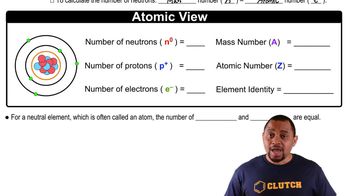
Isotopes

Isotopes are variants of a chemical element that have the same number of protons but different numbers of neutrons. For example, uranium-235 (235U) and uranium-238 (238U) are isotopes of uranium, with 235U having 143 neutrons and 238U having 146 neutrons. This difference in neutron count affects their stability and radioactive properties.
추천 영상:

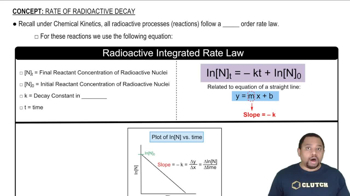
Radioactive Decay

Radioactive decay is the process by which an unstable atomic nucleus loses energy by emitting radiation. In the case of 238U decaying to 234Th, it undergoes alpha decay, where it emits an alpha particle (2 protons and 2 neutrons). This process changes the element into a different one, resulting in a loss of protons and neutrons from the original atom.
추천 영상:
가이드 코스
03:00
Rate of Radioactive Decay

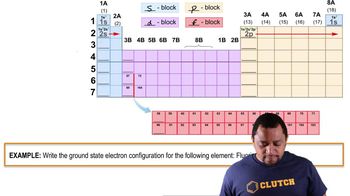
Electron Configuration

Electron configuration describes the distribution of electrons in an atom's orbitals. It is crucial for understanding an element's chemical properties and reactivity. For thorium (Th), the electron configuration can reveal its valence electrons and how it might bond with other elements, which can be surprising if it differs significantly from its predecessor in the decay process.
추천 영상:
가이드 코스
01:33
Electron Configuration Example