Ch.7 - Periodic Properties of the Elements
Brown - Chemistry: The Central Science 14th Edition
Brown14th EditionChemistry: The Central ScienceISBN: 9780134414232당신이 사용하는 게 아니라요?교과서 변경
7장, 문제 34

Arrange each of the following sets of atoms and ions, in order of increasing size: (a) Pb, Pb2+, Pb4+

검증된 단계별 안내
1
Step 1: Understand that the size of an atom or ion is determined by the number of electron shells it has and the effective nuclear charge. The more electron shells, the larger the atom or ion. The greater the effective nuclear charge (the net positive charge experienced by an electron in a multi-electron atom), the smaller the atom or ion.
Step 2: Recognize that Pb, Pb2+, and Pb4+ all have the same number of electron shells because they are all based on the lead atom. Therefore, the size difference among them is due to the difference in effective nuclear charge.
Step 3: Realize that the effective nuclear charge increases as the atom loses electrons and becomes a cation (a positively charged ion). This is because there are fewer electrons to shield the nuclear charge, so the remaining electrons are drawn closer to the nucleus, making the ion smaller.
Step 4: Apply this knowledge to the given set of atoms and ions. Pb has the least effective nuclear charge because it has the most electrons. Pb2+ has a greater effective nuclear charge because it has lost two electrons. Pb4+ has the greatest effective nuclear charge because it has lost four electrons.
Step 5: Arrange the atoms and ions in order of increasing size based on their effective nuclear charges. The one with the greatest effective nuclear charge will be the smallest, and the one with the least effective nuclear charge will be the largest. Therefore, the order of increasing size is Pb4+, Pb2+, Pb.

비슷한 문제에 대한 검증된 영상 답변:

이 영상 해법은 위 문제에 도움이 된다고 튜터들이 추천한 것입니다.
영상 길이:
2m

주요 개념

질문에 올바르게 답하기 위해 반드시 이해해야 하는 핵심 개념들은 다음과 같습니다.

Atomic Radius

The atomic radius is a measure of the size of an atom, typically defined as the distance from the nucleus to the outermost electron shell. Atomic size generally increases down a group in the periodic table due to the addition of electron shells, while it decreases across a period from left to right due to increased nuclear charge, which pulls electrons closer to the nucleus.
추천 영상:

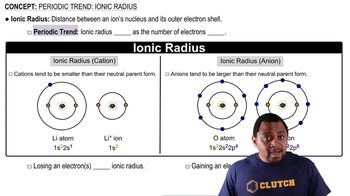
Ionic Radius

The ionic radius refers to the size of an ion in a crystal lattice. Cations (positively charged ions) are smaller than their neutral atoms because the loss of electrons reduces electron-electron repulsion and allows the remaining electrons to be pulled closer to the nucleus. Conversely, anions (negatively charged ions) are larger than their neutral atoms due to increased electron-electron repulsion from the added electrons.
추천 영상:

Charge and Size Relationship

The charge of an ion significantly affects its size. For a given element, as the positive charge increases (e.g., from Pb to Pb2+ to Pb4+), the ionic radius decreases due to the increased effective nuclear charge acting on the remaining electrons. This results in a stronger attraction between the nucleus and the electrons, pulling them closer and reducing the overall size of the ion.
추천 영상: