Write a balanced equation for the reaction that occurs in each of the following cases: (a) Cesium is added to water.
Ch.7 - Periodic Properties of the Elements
7장, 문제 69a
Write a balanced equation for the reaction that occurs in each of the following cases: (a) Potassium metal is exposed to an atmosphere of chlorine gas.
검증된 단계별 안내1
Identify the reactants involved in the reaction. In this case, the reactants are potassium metal (K) and chlorine gas (Cl2).
Write the unbalanced chemical equation by placing the reactants on the left side and the products on the right side. Since potassium reacts with chlorine, the product is potassium chloride (KCl). The unbalanced equation is: K + Cl2 → KCl.
Balance the equation by adjusting the coefficients to ensure that the number of atoms for each element is the same on both sides of the equation. Start by balancing the chlorine atoms.
After balancing the chlorine, adjust the coefficients for potassium so that the number of potassium atoms is equal on both sides of the equation.
Verify that the equation is balanced by counting the atoms of each element on both sides of the equation to ensure they are equal.

비슷한 문제에 대한 검증된 영상 답변:
이 영상 해법은 위 문제에 도움이 된다고 튜터들이 추천한 것입니다.
영상 길이:
1m주요 개념
질문에 올바르게 답하기 위해 반드시 이해해야 하는 핵심 개념들은 다음과 같습니다.
Balancing Chemical Equations
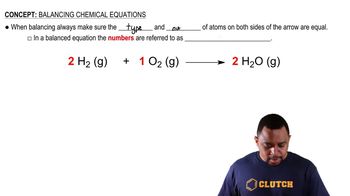
Balancing chemical equations involves ensuring that the number of atoms of each element is the same on both sides of the equation. This is based on the law of conservation of mass, which states that matter cannot be created or destroyed in a chemical reaction. To balance an equation, coefficients are adjusted in front of the chemical formulas to achieve equal atom counts.
추천 영상:
가이드 코스
Balancing Chemical Equations
Reactivity of Alkali Metals
Alkali metals, such as potassium, are highly reactive, especially with halogens like chlorine. When potassium reacts with chlorine gas, it forms potassium chloride. This reaction is characterized by the transfer of electrons from the alkali metal to the halogen, resulting in the formation of ionic bonds and the release of energy in the form of heat and light.
추천 영상:
가이드 코스
Transition Metals
Ionic Compounds Formation
Ionic compounds are formed when metals react with nonmetals, resulting in the transfer of electrons. In the case of potassium and chlorine, potassium donates one electron to chlorine, leading to the formation of K+ and Cl- ions. These oppositely charged ions attract each other, creating a stable ionic compound, potassium chloride (KCl), which can be represented in a balanced chemical equation.
추천 영상:
가이드 코스
Ionic Compounds Naming
관련 실천
교과서 질문
644
views
교과서 질문
Write a balanced equation for the reaction that occurs in each of the following cases: (b) Strontium oxide is added to water. (c) A fresh surface of lithium metal is exposed to oxygen gas. (d) Sodium metal reacts with molten sulfur.
453
views
교과서 질문
Write a balanced equation for the reaction that occurs in each of the following cases: (c) Sodium reacts with oxygen.
502
views
교과서 질문
(a) As described in Section 7.7, the alkali metals react with hydrogen to form hydrides and react with halogens to form halides. Compare the roles of hydrogen and halogens in these reactions. Write balanced equations for the reaction of fluorine with calcium and for the reaction of hydrogen with calcium. (b) What is the oxidation number and electron configuration of calcium in each product?
513
views