Ch.8 - Basic Concepts of Chemical Bonding
Brown - Chemistry: The Central Science 14th Edition
Brown14th EditionChemistry: The Central ScienceISBN: 9780134414232당신이 사용하는 게 아니라요?교과서 변경
8장, 문제 89b

Although I3- is a known ion, F3- is not. (b) One of your classmates says that F3- does not exist because F is too electronegative to make bonds with another atom. Give an example that proves your classmate is wrong.

검증된 단계별 안내
1
Understand the concept of electronegativity: Electronegativity is a measure of an atom's ability to attract and hold onto electrons. Fluorine is the most electronegative element, which means it strongly attracts electrons.
Consider the nature of chemical bonding: Despite its high electronegativity, fluorine can form bonds with other atoms, including other fluorine atoms, through covalent bonding. Covalent bonds involve the sharing of electrons between atoms.
Explore known fluorine compounds: Fluorine commonly forms diatomic molecules, such as F2, where two fluorine atoms share electrons equally. This demonstrates that fluorine can indeed bond with other fluorine atoms.
Introduce the concept of polyatomic ions: While F3- is not a known ion, fluorine can form polyatomic ions with other elements. For example, BF4- (tetrafluoroborate) is a stable ion where fluorine atoms are bonded to boron.
Provide a counterexample: Consider the existence of other polyatomic ions involving highly electronegative elements, such as ClO4- (perchlorate), where chlorine, another electronegative element, forms stable bonds with oxygen atoms. This shows that electronegativity does not prevent the formation of bonds in polyatomic ions.

비슷한 문제에 대한 검증된 영상 답변:

이 영상 해법은 위 문제에 도움이 된다고 튜터들이 추천한 것입니다.
영상 길이:
5m

주요 개념

질문에 올바르게 답하기 위해 반드시 이해해야 하는 핵심 개념들은 다음과 같습니다.

Electronegativity

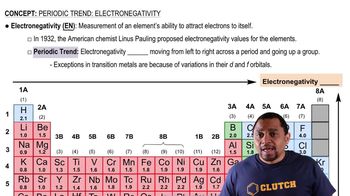
Electronegativity is a measure of an atom's ability to attract and hold onto electrons in a chemical bond. Fluorine is the most electronegative element, which means it strongly attracts electrons. However, high electronegativity does not preclude the formation of bonds; rather, it influences the type of bonds formed, such as covalent or ionic.
추천 영상:
가이드 코스
02:10
Electronegativity Trends

Covalent Bonding

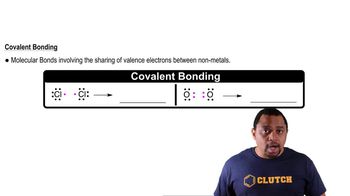
Covalent bonding occurs when two atoms share one or more pairs of electrons to achieve stability. Even highly electronegative elements like fluorine can form covalent bonds with other atoms under certain conditions. For example, in the case of F<sub>2</sub>, two fluorine atoms share electrons, demonstrating that electronegativity does not prevent bond formation.
추천 영상:

Polyatomic Ions

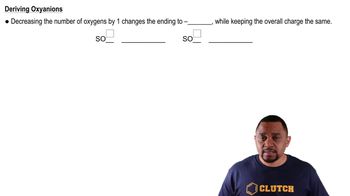
Polyatomic ions are ions composed of two or more atoms that are covalently bonded together and carry a net charge. The existence of polyatomic ions like I<sub>3</sub><sup>-</sup> shows that groups of atoms can bond and carry a charge, regardless of the individual electronegativities of the atoms involved. This indicates that F<sub>3</sub><sup>-</sup> could theoretically exist as a polyatomic ion.
추천 영상:
가이드 코스
01:20
Polyatomic Ion Variations
관련 실천
교과서 질문

Calculate the formal charge on the indicated atom in each of the following molecules or ions: (a) the central oxygen atom in O3 (b) phosphorus in PF6- (c) nitrogen in NO2 (d) iodine in ICl3 (e) chlorine in HClO4 (hydrogen is bonded to O).

1
views
교과서 질문

The hypochlorite ion, ClO-, is the active ingredient in bleach. The perchlorate ion, ClO4-, is a main component of rocket propellants. Draw Lewis structures for both ions. (b) What is the formal charge of Cl in the perchlorate ion, assuming the Cl—O bonds are all single bonds?

921
views
교과서 질문

A major challenge in implementing the 'hydrogen economy' is finding a safe, lightweight, and compact way of storing hydrogen for use as a fuel. The hydrides of light metals are attractive for hydrogen storage because they can store a high weight percentage of hydrogen in a small volume. For example, NaAlH4 can release 5.6% of its mass as H2 upon decomposing to NaH(s), Al(s), and H2(g). NaAlH4 possesses both covalent bonds, which hold polyatomic anions together, and ionic bonds. (c) Based on electronegativity differences, predict the identity of the polyatomic anion. Draw a Lewis structure for this ion.

424
views
교과서 질문

A major challenge in implementing the 'hydrogen economy' is finding a safe, lightweight, and compact way of storing hydrogen for use as a fuel. The hydrides of light metals are attractive for hydrogen storage because they can store a high weight percentage of hydrogen in a small volume. For example, NaAlH4 can release 5.6% of its mass as H2 upon decomposing to NaH(s), Al(s), and H2(g). NaAlH4 possesses both covalent bonds, which hold polyatomic anions together, and ionic bonds. (b) Which element in NaAlH4 is the most electronegative? Which one is the least electronegative? Which element in NaAlH4 is the least electronegative?

365
views
교과서 질문

A major challenge in implementing the 'hydrogen economy' is finding a safe, lightweight, and compact way of storing hydrogen for use as a fuel. The hydrides of light metals are attractive for hydrogen storage because they can store a high weight percentage of hydrogen in a small volume. For example, NaAlH4 can release 5.6% of its mass as H2 upon decomposing to NaH(s), Al(s), and H2(g). NaAlH4 possesses both covalent bonds, which hold polyatomic anions together, and ionic bonds. (d) What is the formal charge on hydrogen in the polyatomic ion?

338
views
교과서 질문

Although I3- is a known ion, F3- is not. (c) Another classmate says F3- does not exist because it would violate the octet rule. Is this classmate possibly correct?

871
views