Ch.8 - Basic Concepts of Chemical Bonding
Brown - Chemistry: The Central Science 14th Edition
Brown14th EditionChemistry: The Central ScienceISBN: 9780134414232당신이 사용하는 게 아니라요?교과서 변경
8장, 문제 36c

(c) Do you expect the O—O bond in H2O2 to be longer or shorter than the O—O bond in O2? Explain.

검증된 단계별 안내
1
Identify the molecular structure of both H2O2 (hydrogen peroxide) and O2 (oxygen gas). Hydrogen peroxide has a bent structure due to the presence of lone pairs on oxygen atoms, while oxygen gas is a diatomic molecule with a double bond between the oxygen atoms.
Consider the types of bonds present in each molecule. In H2O2, the oxygen atoms are connected by a single bond, whereas in O2, the oxygen atoms are connected by a double bond.
Recall that double bonds are generally shorter and stronger than single bonds due to the increased electron density between the atoms.
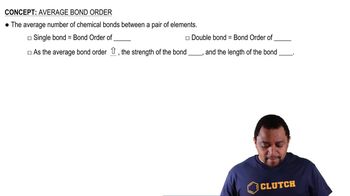
Apply the concept that the length of the bond is inversely related to the bond order (number of chemical bonds between a pair of atoms). A higher bond order typically results in a shorter bond.
Conclude that based on the bond order and the type of bonding, the O—O bond in O2 (double bond) is expected to be shorter than the O—O bond in H2O2 (single bond).

비슷한 문제에 대한 검증된 영상 답변:

이 영상 해법은 위 문제에 도움이 된다고 튜터들이 추천한 것입니다.
영상 길이:
5m

주요 개념

질문에 올바르게 답하기 위해 반드시 이해해야 하는 핵심 개념들은 다음과 같습니다.

Bond Length

Bond length refers to the distance between the nuclei of two bonded atoms. It is influenced by factors such as atomic size, bond order, and the presence of lone pairs. Generally, shorter bonds indicate stronger interactions between atoms, while longer bonds suggest weaker interactions.
추천 영상:
가이드 코스
00:36
Average Bond Order

Bond Order

Bond order is a measure of the number of chemical bonds between a pair of atoms. In simple terms, a higher bond order (e.g., double or triple bonds) typically results in shorter bond lengths due to increased electron sharing. In contrast, a single bond has a lower bond order and is usually longer.
추천 영상:
가이드 코스
00:36
Average Bond Order

Lone Pairs and Steric Effects

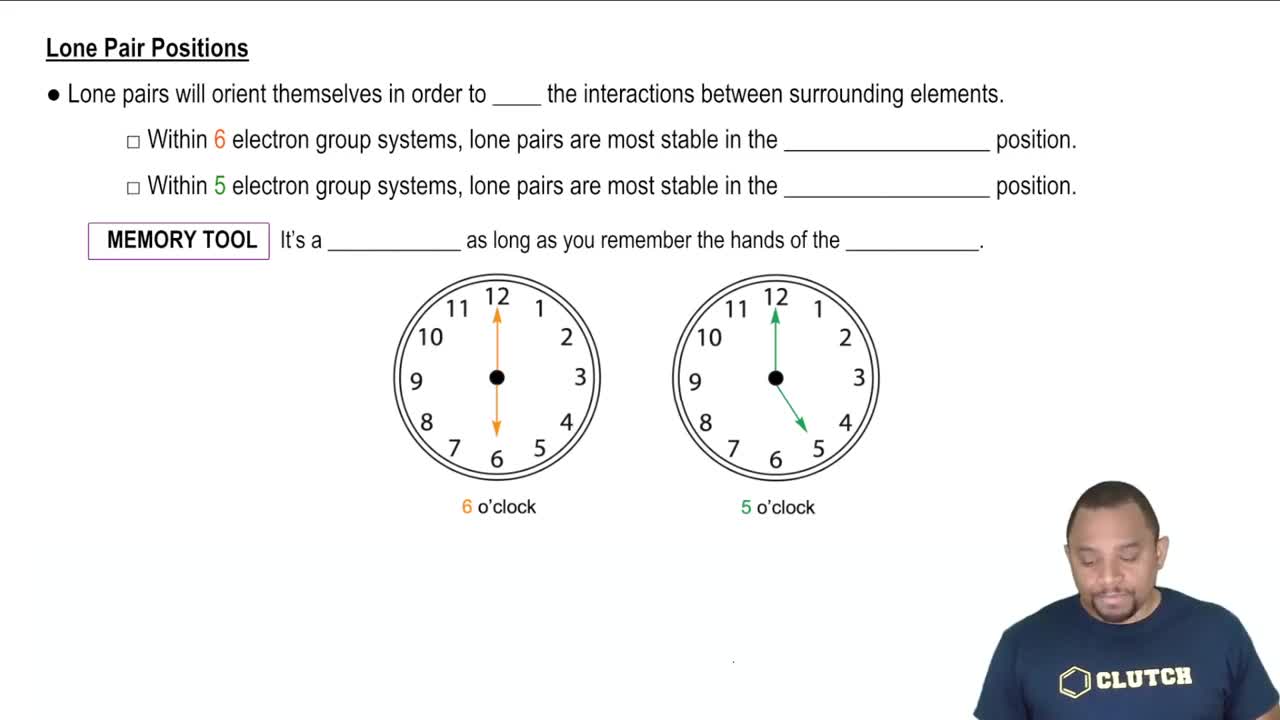
Lone pairs are pairs of valence electrons that are not involved in bonding. In molecules like H2O2, the presence of lone pairs on oxygen atoms can create repulsive forces that affect bond lengths. This steric effect can lead to longer bond lengths compared to molecules with fewer or no lone pairs, such as O2.
추천 영상:
가이드 코스
01:33
Lone Pair Positions