Ch.8 - Basic Concepts of Chemical Bonding
Brown - Chemistry: The Central Science 14th Edition
Brown14th EditionChemistry: The Central ScienceISBN: 9780134414232당신이 사용하는 게 아니라요?교과서 변경
8장, 문제 14a,b

What is the Lewis symbol for each of the following atoms or ions? (a) Be (b) Rb

검증된 단계별 안내
1
Understand the concept of Lewis symbols: Lewis symbols represent the valence electrons of an atom or ion using dots around the chemical symbol. Each dot represents one valence electron.
Determine the number of valence electrons for each atom or ion: (a) Beryllium (Be) is in Group 2 of the periodic table, so it has 2 valence electrons. (b) Rubidium (Rb) is in Group 1, so it has 1 valence electron.
Draw the Lewis symbol for Beryllium (Be): Place the chemical symbol 'Be' and surround it with two dots representing its two valence electrons. The dots are typically placed on opposite sides of the symbol.
Draw the Lewis symbol for Rubidium (Rb): Place the chemical symbol 'Rb' and surround it with one dot representing its single valence electron.
Consider ions if applicable: If the problem involves ions, adjust the number of valence electrons accordingly. For example, if Be were to form a Be²⁺ ion, it would lose its two valence electrons, resulting in no dots around the symbol.

비슷한 문제에 대한 검증된 영상 답변:

이 영상 해법은 위 문제에 도움이 된다고 튜터들이 추천한 것입니다.
영상 길이:
26s

주요 개념

질문에 올바르게 답하기 위해 반드시 이해해야 하는 핵심 개념들은 다음과 같습니다.

Lewis Symbols

Lewis symbols are a way to represent the valence electrons of an atom or ion using dots around the element's symbol. Each dot corresponds to a valence electron, which are the electrons involved in chemical bonding. This representation helps visualize how atoms interact and form bonds with one another.
추천 영상:
가이드 코스
00:52
Lewis Dot Symbols

Valence Electrons

Valence electrons are the outermost electrons of an atom and are crucial in determining how an atom will bond with others. The number of valence electrons varies by element and can be found by looking at the group number in the periodic table. For example, beryllium (Be) has two valence electrons, while rubidium (Rb) has one.
추천 영상:
가이드 코스
02:12
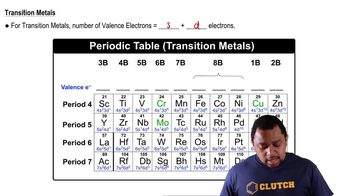
Transition Metals Valence Electrons

Ionic vs. Neutral Atoms

Ionic atoms have gained or lost electrons, resulting in a net charge, while neutral atoms have an equal number of protons and electrons. For instance, when beryllium forms a cation (Be²⁺), it loses its two valence electrons, whereas rubidium (Rb) typically forms a cation (Rb⁺) by losing one valence electron. This distinction is important when drawing their Lewis symbols.
추천 영상:
가이드 코스
04:13
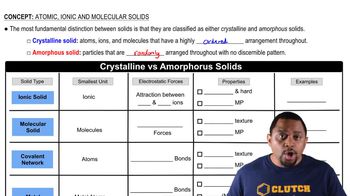
Crystalline vs Amorphous Solids