Ch.1 - Introduction: Matter, Energy, and Measurement
Brown - Chemistry: The Central Science 15th Edition
Brown15th EditionChemistry: The Central ScienceISBN: 9780137542970당신이 사용하는 게 아니라요?교과서 변경
1장, 문제 52

Carry out the following operations and express the answers in exponential notation with the appropriate number of significant figures.
a. 2.791×10⁴ + 8.76×10³
b. 4.67×10² − 5.4437×10⁴
c. (2.481×10⁻² + 7.33×10−4) × (1.924×10−2 + 6.70)
d. (1.3×10⁻⁴ − 3.746×10⁻²)/(1.3×102 − 3.746×10⁴)

검증된 단계별 안내
1
a. Align the exponents for the addition: Convert 8.76×10^3 to 0.876×10^4, then add 2.791×10^4 and 0.876×10^4.
a. Perform the addition: 2.791 + 0.876 = 3.667, then express the result in exponential notation as 3.667×10^4.
b. Align the exponents for the subtraction: Convert 4.67×10^2 to 0.0467×10^4, then subtract 5.4437×10^4 from 0.0467×10^4.
b. Perform the subtraction: 0.0467 - 5.4437 = -5.397, then express the result in exponential notation as -5.397×10^4.
c. First, perform the addition inside the parentheses: (2.481×10^−2 + 7.33×10^−4) and (1.924×10^−2 + 6.70), then multiply the results.

비슷한 문제에 대한 검증된 영상 답변:

이 영상 해법은 위 문제에 도움이 된다고 튜터들이 추천한 것입니다.
영상 길이:
1m

주요 개념

질문에 올바르게 답하기 위해 반드시 이해해야 하는 핵심 개념들은 다음과 같습니다.

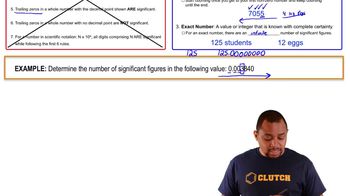
Significant Figures

Significant figures are the digits in a number that contribute to its precision. This includes all non-zero digits, any zeros between significant digits, and trailing zeros in the decimal portion. When performing calculations, the result should be reported with the same number of significant figures as the measurement with the least number of significant figures to ensure accuracy.
추천 영상:
가이드 코스
01:09
Significant Figures Example

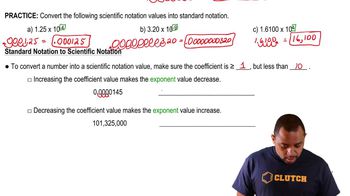
Exponential Notation

Exponential notation is a way of expressing numbers that are too large or too small to be conveniently written in decimal form. It is represented as a product of a number (the coefficient) and a power of ten. For example, 2.791×10^4 means 2.791 multiplied by 10,000. This notation simplifies calculations and helps maintain significant figures.
추천 영상:
가이드 코스
02:50
Standard Notation to Scientific Notation

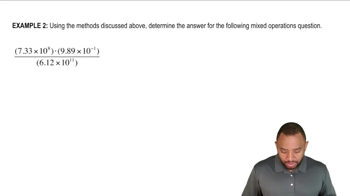
Order of Operations

The order of operations is a set of rules that dictates the sequence in which calculations should be performed to ensure consistent results. The common acronym PEMDAS (Parentheses, Exponents, Multiplication and Division, Addition and Subtraction) helps remember this order. Following these rules is crucial when performing multiple operations, especially in complex expressions involving addition, subtraction, multiplication, and division.
추천 영상:
가이드 코스
03:10
Scientific Notation Mixed Operations