Ch.1 - Introduction: Matter, Energy, and Measurement
Brown - Chemistry: The Central Science 15th Edition
Brown15th EditionChemistry: The Central ScienceISBN: 9780137542970당신이 사용하는 게 아니라요?교과서 변경
1장, 문제 30

The mass of a helium atom is roughly four times that of a hydrogen atom. The mass of an oxygen atom is roughly 16 times that of a hydrogen atom.
a. For each of the following pairs, choose the one that has the greater kinetic energy: (i) a H atom moving at 1000 m/s or a He atom moving at 400 m/s, (ii) a H atom moving at 1000 m/s or an O atom moving at 400 m/s, (iii) a He atom moving at 1000 m/s or an O atom moving at 400 m/s.
b. A He atom is moving at 800 m/s. What is the speed of an O atom that has the same kinetic energy as the He atom?

검증된 단계별 안내
1
Step 1: Recall the formula for kinetic energy: \( KE = \frac{1}{2}mv^2 \), where \( m \) is the mass and \( v \) is the velocity of the particle.
Step 2: For part (a), compare the kinetic energies of the given pairs by substituting the respective masses and velocities into the kinetic energy formula. Remember that the mass of a helium atom is 4 times that of a hydrogen atom, and the mass of an oxygen atom is 16 times that of a hydrogen atom.
Step 3: For part (a)(i), calculate the kinetic energy of a hydrogen atom moving at 1000 m/s and a helium atom moving at 400 m/s. Compare the two values to determine which has greater kinetic energy.
Step 4: For part (a)(ii), calculate the kinetic energy of a hydrogen atom moving at 1000 m/s and an oxygen atom moving at 400 m/s. Compare the two values to determine which has greater kinetic energy.
Step 5: For part (b), set the kinetic energy of the helium atom equal to the kinetic energy of the oxygen atom and solve for the velocity of the oxygen atom. Use the relationship \( \frac{1}{2}m_{He}v_{He}^2 = \frac{1}{2}m_{O}v_{O}^2 \) to find \( v_{O} \).

비슷한 문제에 대한 검증된 영상 답변:

이 영상 해법은 위 문제에 도움이 된다고 튜터들이 추천한 것입니다.
영상 길이:
5m

주요 개념

질문에 올바르게 답하기 위해 반드시 이해해야 하는 핵심 개념들은 다음과 같습니다.

Kinetic Energy

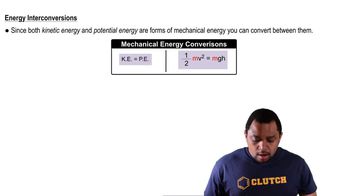
Kinetic energy (KE) is the energy an object possesses due to its motion, calculated using the formula KE = 1/2 mv², where m is mass and v is velocity. This means that both the mass of the object and its speed significantly influence its kinetic energy. In comparing two objects, the one with greater mass or higher speed will generally have more kinetic energy.
추천 영상:
가이드 코스
00:34
Kinetic & Potential Energy

Mass and Velocity Relationship

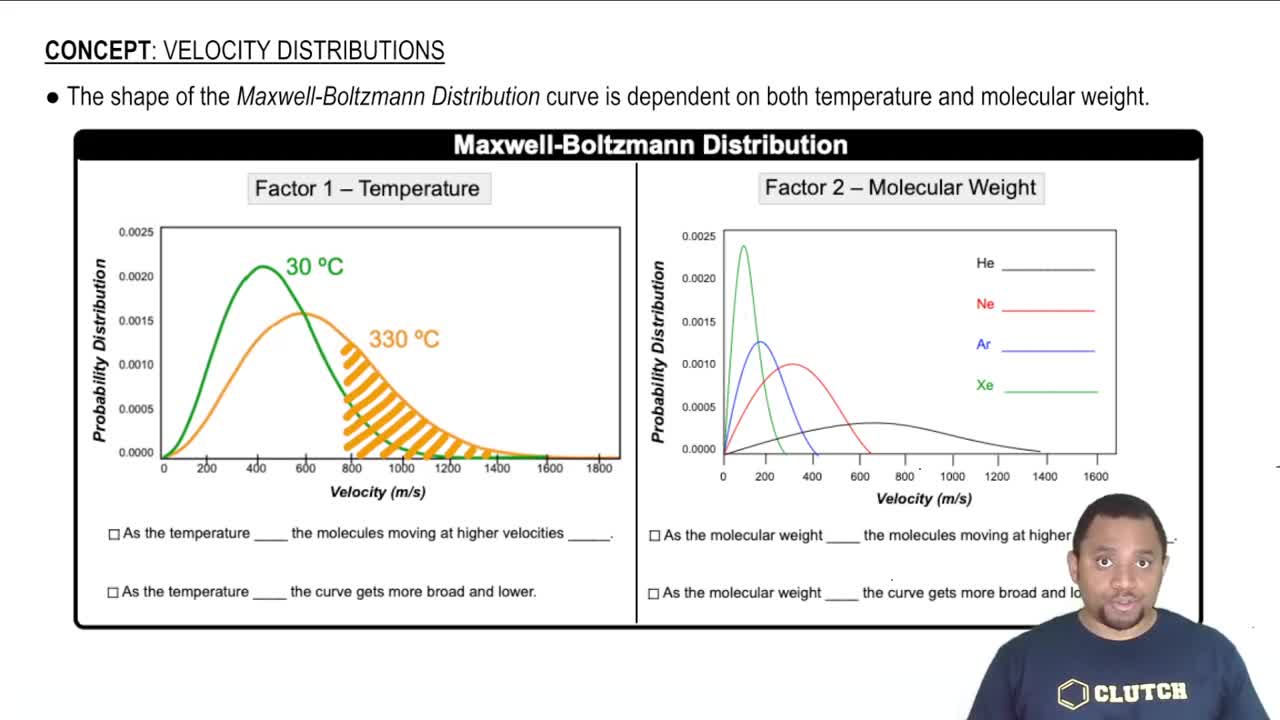
In the context of kinetic energy, the relationship between mass and velocity is crucial. A heavier object moving at a lower speed can have the same or greater kinetic energy than a lighter object moving faster, depending on the specific values of mass and velocity. This principle is essential for comparing the kinetic energies of different atoms in the given question.
추천 영상:
가이드 코스
02:47
Velocity Distributions

Conservation of Energy

The principle of conservation of energy states that energy cannot be created or destroyed, only transformed from one form to another. In this question, when comparing the kinetic energies of different atoms, the total energy remains constant, allowing us to equate the kinetic energies of the helium and oxygen atoms to find the unknown speed of the oxygen atom.
추천 영상:
가이드 코스
01:48
Law of Conservation of Mass
관련 실천
교과서 질문

(a) Calculate the kinetic energy (in joules) of a 1200-kg automobile moving at 18 m/s.

2
views

교과서 질문

A soccer ball is dropped out of a window on the second floor of a dormitory to the ground below. Which of the following statements is or are true?

i. The kinetic energy of the ball is greatest at the time it is dropped out the window.

ii. As the ball falls, potential energy is converted into kinetic energy.

iii. The potential energy of the ball is due to the force of gravity acting on it.

교과서 질문

For each of the following processes, does the potential energy of the object(s) increase or decrease? (b) Water is pumped from ground level to the reservoir of a water tower 30 m above the ground.

455
views
교과서 질문

A silvery metal is put inside a beaker of water. Bubbles form on the surface of the metal and it dissolves gradually. (a) Is this an example of a chemical or a physical change?

692
views
교과서 질문

Two positively charged particles are first brought close together and then released. Once released, the repulsion between particles causes them to move away from each other. a. This is an example of potential energy being converted into what form of energy?

3
views
교과서 질문

Two positively charged particles are first brought close together and then released. Once released, the repulsion between particles causes them to move away from each other. b. Does the electrostatic potential energy of the two particles increase or decrease as the distance between them is increased?

2
views