Ch.1 - Introduction: Matter, Energy, and Measurement
Brown - Chemistry: The Central Science 15th Edition
Brown15th EditionChemistry: The Central ScienceISBN: 9780137542970당신이 사용하는 게 아니라요?교과서 변경
1장, 문제 20

You are hiking in the mountains and find a shiny gold nugget. It might be the element gold, or it might be “fool’s gold,” which is a nickname for iron pyrite, FeS2. Which of the following physical properties do you think would help determine if the shiny nugget is really gold—appearance, melting point, density, or physical state?

검증된 단계별 안내
1
Identify the physical properties of gold and iron pyrite (FeS_2) that can be used to distinguish between them.
Consider the appearance: Both gold and iron pyrite have a shiny, metallic appearance, so this property alone may not be sufficient to distinguish them.
Consider the melting point: Gold has a melting point of 1064°C, while iron pyrite decomposes at around 743°C. Measuring the melting point could help differentiate them.
Consider the density: Gold has a high density of about 19.32 g/cm^3, whereas iron pyrite has a lower density of about 5.0 g/cm^3. Measuring the density of the nugget could be a reliable method to identify it.
Consider the physical state: Both substances are solid at room temperature, so this property would not help in distinguishing them.

비슷한 문제에 대한 검증된 영상 답변:

이 영상 해법은 위 문제에 도움이 된다고 튜터들이 추천한 것입니다.
영상 길이:
4m

주요 개념

질문에 올바르게 답하기 위해 반드시 이해해야 하는 핵심 개념들은 다음과 같습니다.

Physical Properties

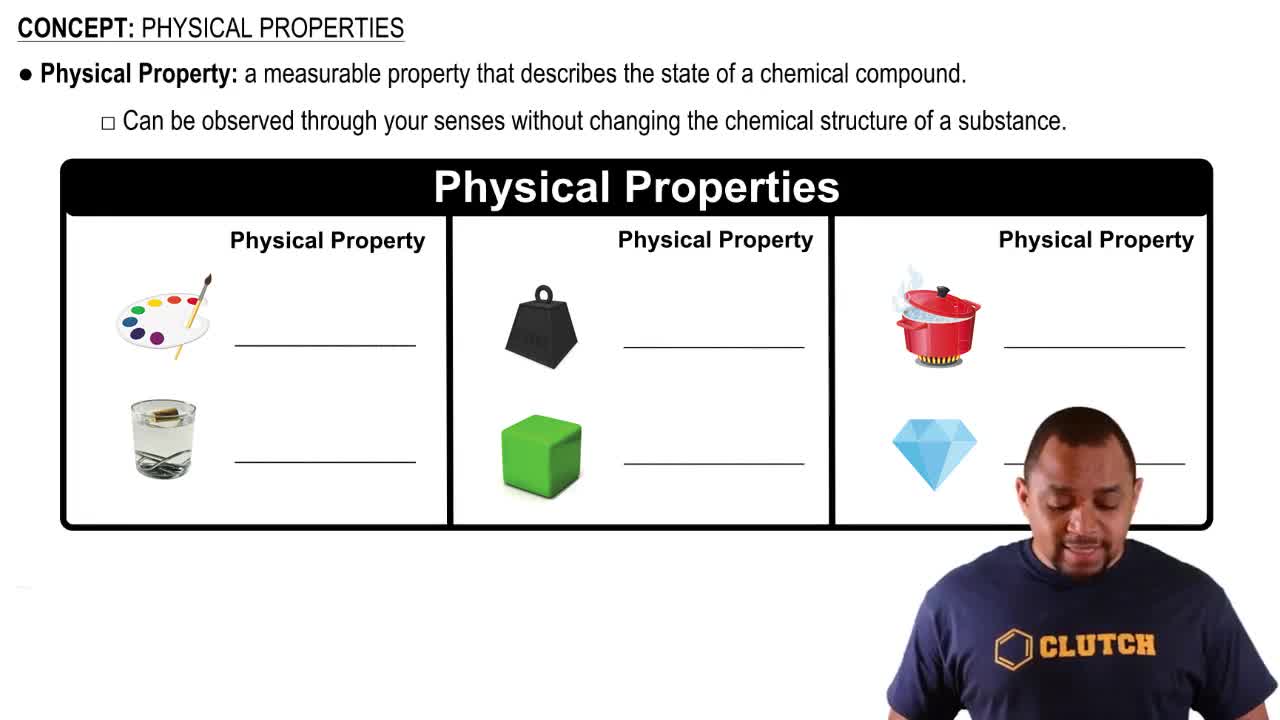
Physical properties are characteristics of a substance that can be observed or measured without changing its chemical identity. These include appearance, melting point, density, and physical state. Understanding these properties is crucial for distinguishing between substances, such as gold and iron pyrite, as they exhibit different physical characteristics.
추천 영상:
가이드 코스
02:54
Physical Properties

Density

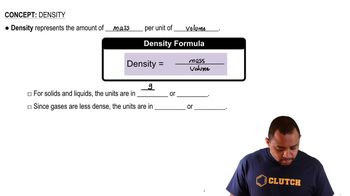
Density is defined as mass per unit volume and is a key physical property used to identify substances. Gold has a significantly higher density (approximately 19.32 g/cm³) compared to iron pyrite (about 5.0 g/cm³). By measuring the density of the nugget, one can effectively differentiate between gold and fool's gold.
추천 영상:
가이드 코스
01:56
Density Concepts

Melting Point

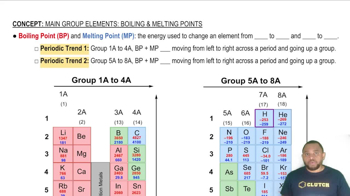
The melting point is the temperature at which a solid becomes a liquid. Gold has a melting point of 1,064 °C, while iron pyrite melts at a much higher temperature, around 1,177 °C. Knowing the melting points of these substances can help in identifying the nugget, as it can be tested under controlled conditions to observe its behavior when heated.
추천 영상:
가이드 코스
04:29
Boiling Point and Melting Point
관련 실천
교과서 질문

Classify each of the following as a pure substance or a mixture. If a mixture, indicate whether it is homogeneous or heterogeneous: (d) sawdust.

2
views

교과서 질문

(b) Which properties of zinc can you describe from the photo? Are these physical or chemical properties?

511
views
교과서 질문

Give the chemical symbol or name for the following elements, as appropriate: c. potassium

3
views
교과서 질문

In the process of attempting to characterize a substance, a chemist makes the following observations: The substance is a silvery white, lustrous metal. It melts at 649 °C and boils at 1105 °C. Its density at 20 °C is 1.738 g/cm3. The substance burns in air, producing an intense white light. It reacts with chlorine to give a brittle white solid. The substance can be pounded into thin sheets or drawn into wires. It is a good conductor of electricity. Which of these characteristics are physical properties, and which are chemical properties?

1161
views
1
rank
교과서 질문

Give the chemical symbol or name for each of the following elements, as appropriate: a. carbon

3
views
교과서 질문

(a) Read the following description of the element zinc and indicate which are physical properties and which are chemical properties. Zinc melts at 420 °C. When zinc granules are added to dilute sulfuric acid, hydrogen is given off and the metal dissolves. Zinc has a hardness on the Mohs scale of 2.5 and a density of 7.13 g/cm3 at 25 °C. It reacts slowly with oxygen gas at elevated temperatures to form zinc oxide, ZnO.

866
views