
Ch.10 - Gases
Brown - Chemistry: The Central Science 15th Edition
Brown15th EditionChemistry: The Central ScienceISBN: 9780137542970당신이 사용하는 게 아니라요?교과서 변경
10장, 문제 84

At constant pressure, the mean free path 1l2 of a gas molecule is directly proportional to temperature. At constant temperature, l is inversely proportional to pressure. If you compare two different gas molecules at the same temperature and pressure, l is inversely proportional to the square of the diameter of the gas molecules. Put these facts together to create a formula for the mean free path of a gas molecule with a proportionality constant (call it Rmfp, like the ideal-gas constant) and define units for Rmfp.

검증된 단계별 안내
1
Step 1: From the problem, we know that the mean free path (l) of a gas molecule is directly proportional to temperature (T) at constant pressure. This can be written as l ∝ T.
Step 2: We also know that at constant temperature, l is inversely proportional to pressure (P). This can be written as l ∝ 1/P.
Step 3: Furthermore, if we compare two different gas molecules at the same temperature and pressure, l is inversely proportional to the square of the diameter (d) of the gas molecules. This can be written as l ∝ 1/d².
Step 4: Combining these three relationships, we can write a formula for the mean free path as l = Rmfp * (T/P) * (1/d²), where Rmfp is the proportionality constant, similar to the ideal-gas constant.
Step 5: The units for Rmfp can be derived from the equation. Since l, T, P, and d have units of length, temperature, pressure, and length respectively, the units for Rmfp would be (length² * pressure) / (temperature * length²) = pressure/temperature. This is the same as the ideal gas constant R, which has units of J/(mol*K) in SI units, or L*atm/(mol*K) in common chemistry units.

비슷한 문제에 대한 검증된 영상 답변:

이 영상 해법은 위 문제에 도움이 된다고 튜터들이 추천한 것입니다.
영상 길이:
7m

주요 개념

질문에 올바르게 답하기 위해 반드시 이해해야 하는 핵심 개념들은 다음과 같습니다.

Mean Free Path

The mean free path is the average distance a gas molecule travels between collisions with other molecules. It is influenced by factors such as temperature, pressure, and the size of the molecules. A longer mean free path indicates fewer collisions, while a shorter mean free path suggests more frequent interactions among gas particles.
추천 영상:
가이드 코스
01:05
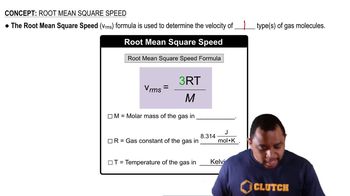
Root Mean Square Speed Formula

Gas Laws

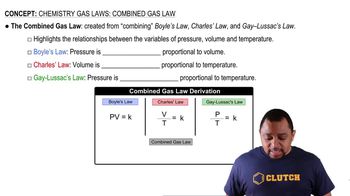
Gas laws describe the behavior of gases in relation to pressure, volume, and temperature. Key laws include Boyle's Law, which states that pressure is inversely proportional to volume at constant temperature, and Charles's Law, which states that volume is directly proportional to temperature at constant pressure. Understanding these relationships is crucial for deriving formulas related to gas behavior.
추천 영상:
가이드 코스
01:43
Combined Gas Law

Proportionality and Constants

In physics and chemistry, proportionality indicates how one quantity changes in relation to another. When deriving formulas, constants like Rmfp serve as proportionality constants that relate different variables. For the mean free path, the constant Rmfp would encapsulate the effects of temperature, pressure, and molecular size, allowing for a unified equation to predict gas behavior.
추천 영상:
가이드 코스
01:14
Equilibrium Constant K
관련 실천
교과서 질문

Which one or more of the following statements are true? (a) O2 will effuse faster than Cl2. (b) Effusion and diffusion are different names for the same process. (c) Perfume molecules travel to your nose by the process of effusion. (d) The higher the density of a gas, the shorter the mean free path.

1028
views
교과서 질문

A gas of unknown molecular mass was allowed to effuse through a small opening under constant-pressure conditions. It required 105 s for 1.0 L of the gas to effuse. Under identical experimental conditions it required 31 s for 1.0 L of O2 gas to effuse. Calculate the molar mass of the unknown gas. (Remember that the faster the rate of effusion, the shorter the time required for effusion of 1.0 L; in other words, rate is the amount that diffuses over the time it takes to diffuse.)

1825
views
교과서 질문

(c) Calculate the most probable speeds of Cl2 molecules at 300 K.

131
views
교과서 질문

Hydrogen has two naturally occurring isotopes, 1H and 2H. Chlorine also has two naturally occurring isotopes, 35Cl and 37Cl. Thus, hydrogen chloride gas consists of four distinct types of molecules: 1H35Cl, 1H37Cl, 2H35Cl, and 2H37Cl. Place these four molecules in order of increasing rate of effusion.

1412
views
교과서 질문

(c) Calculate the most probable speeds of CO molecules at 300 K.

123
views
교과서 질문

Arsenic(III) sulfide sublimes readily, even below its melting point of 320 °C. The molecules of the vapor phase are found to effuse through a tiny hole at 0.52 times the rate of effusion of Xe atoms under the same conditions of temperature and pressure. What is the molecular formula of arsenic(III) sulfide in the gas phase?

1628
views